Sunday, August 3, 2014

The Man in the Orange Jacket--Aik Karapetian (2014)

"Woman in Peril," chased by a sadistic madman, is par for the course in Karapetian's The Man in the Orange Jacket (2014)
Like several of the films that I saw at the Fantasia Film Festival, Aik Karapetian's The Man in the Orange Jacket (Man in OJ) is an excellent example of squandered potential.  On the whole, the film is fairly derivative of films where a sadistic killer, out of misplaced desire turned to aggression, hunts down a bunch of unlikeable people in a remote location, and dispatches them through a wide selection of weapons/tools.  If Karapetian is attempting to craft a story where we are not sympathetic towards the victims or the perpetrator, he succeeds.  Yet the film has some significant moments that suggest that he's trying for something more complex and powerful--especially in regards to Eastern European class tensions.

The camera tracks our killer as he jogs on the property
Here is where the film works: the cinematography in the Man in OJ is simply stunning, and the multiple tracking shots in the beginning of the film as it follows the man (Maxim Lazarev) leave his harbor job, travel to his boss's home, kill both the big wig and his younger wife, and then proceed to live "large" in the mansion he has invaded--well, these images are gorgeous.  Karapetian masterfully manipulates the space of the mansion, and his opening and closing of the doors that divide this space increases the film's tensions exponentially.  Shadows and light create a misty, grey netherworld where what is real and fantasy becomes more and more unclear.

The Man in OJ lounges in his new-found solarium
The film also cleverly explores what it might be like to live like "the haves," when all one has known is what it's like to "have not."  The man initially struggles with his new luxuries.  He wears his male victim's clothes (even though they are not REMOTELY the same size), he lounges in his robe, he smokes his cigars (and hacks violently).  The man goes out to dinner, and gorges on rich food that he has no idea how to eat (when all else fails, use your fingers).  He then proceeds to get violently ill, and tries to recuperate in a bubble bath.  He's not even good at hiring prostitutes.  If I'm being generous, I would say that the film tries to critique the fantasy of affluent masculinity, suggesting that money and power are not easily obtained through violent class overthrow.  At the same time, does the film imply that wealth's pleasures are illusory, or that one just really needs to be "born to it?"  
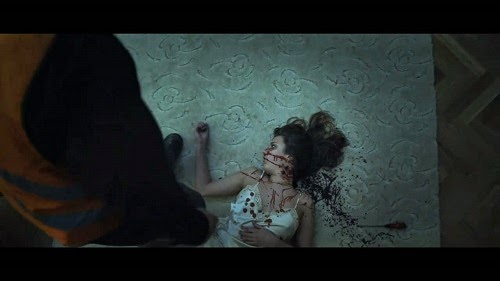
The required half-naked dead girl, snuffed out after a long chase scene
Most of the film's deeper questions fall flat because of the seemingly requisite amount of gendered sexual violence on display.  This particular focus undermines any class critique, as the film frequently devolves into a "boogeyman" with a weapon chase narrative.  The film's kills are straight out of the "Carol Clover guide to slasher films," with the male character dispatched with one blow, and with the women gratuitously clad and on the run from an almost supernaturally empowered killer.  True, the man (in OJ) is shown to be both dis-empowered and riddled by guilt over his deeds, but that part of the film MAKES NO DAMN SENSE unless one chalks up the whole thing to fantasies nestled in his deranged mind.  Major cop-out.  

I initially was hoping that the film was transforming into a circular pattern, where another Man in OJ shows up, and, thinking the first man (in OJ) is the boss (who recently laid off thousands of people who work at the harbor), he goes all homicidal on him.  So the man who initially INVADES the home gets his home invaded, and so on, and so on, infinity.  (I think these time travel, mind fu** films are starting to infect my brain).  See, here is where the film had some real potential! Yeah, but that narrative does not happen.  Instead, the man seems to have a lot of misplaced, unmotivated guilt (which undermines all his previous actions), and then out of nowhere there's a really dumb Final Girl twist.  Really dumb.  Thankfully, the film clocks in at 71 minutes, so it's over pretty quickly.  I wouldn't say that it's not worth seeing for some of its visual inventiveness, but ultimately that The Man in the Orange Jacket disappoints.

The Midnight Swim--Sarah Adina Smith (2014)

June's (Lindsay Burdge) forlorn selfie from Sarah Adina Smith's The Midnight Swim (2014)
I cannot help but cheer when a new female filmmaker breaks out with a powerful, enigmatic film.  Sarah Adina Smith's debut feature The Midnight Swim (2014) has a mystical, ethereal quality which does not make it fit neatly into the "horror cinema" box.  Yet the film's mysteries, and their psychological effects on its characters, help create a very haunted atmosphere, saturated with dread.

The film begins as Amelia Brooks' three daughters, sensible Annie (Jennifer Lafleur), sensual Isa (Aleksa Palladino), and awkwardly neurotic June (Lindsay Burdge) reunite in the wake of their mother's disappearance.  None of the women seem especially surprised by their mother's "death," as her life had become focused on finding the bottom of a seemingly bottomless lake--one on which rests the family's vacation home.  The sisters are there, ostensibly, to get their mother's assets in order, but the focus of the story leans more heavily on the intricately knotted relationships between the siblings.  Watching the tensions and affections between these women blossom and unfold is one of the richest pleasures that the film brings.  Smith really nails the rhythms between female siblings.  Their recent loss brings out both their playfulness with each other, as well as their competitiveness.  Mental Illness lurks in their past as well.

Isa, June and Annie lip sych "Free to Be You and Me"
Joined by a childhood pal/crush, Josh (Ross Partridge), one night in fun, the women decide to invoke the "seven sisters" myth--a dark fairy tale that combines a narrative about entrapped femininity, female powerlessness, and nature's thirst for vengeance.  While initially nothing seems to come of it, as the weekend unfolds, strange events start to occur.  Dead birds show up on their doorstep, noises are heard in the night, and someone or something gets a hold of June's video camera and shoots night footage of a midnight swim.  Has one of the seven sisters come back to haunt them, or is their mother talking to them from the other side?

June's camera symbolizes her distorted worldview
The Midnight Swim could be considered largely a "found-footage film" in that from the film's earliest moments, the experiences at the lake are seen exclusively through June's camera lens.  Since June is a documentary filmmaker, this perspective does not seem initially that out of the ordinary.  Annie and Isa seem fairly used to the camera always being present (and recording).  Other characters, not so much.  In one particularly striking scene, a real estate agent over to discuss selling the house is the target of June's scrutiny, and her camera slowly and unnervingly zooms into close-up on this poor woman while she tries to talk to the other sisters.  The scene is funny, yet highlights June's use of the camera as a crutch by which she interacts with the world.  The film's focused visual perspective forces the spectator to spend the most time with June, seeing the world through her eyes.  Yet that perspective becomes problematic when it becomes more and more clear that June is an unreliable and perhaps rather unstable narrator.  The film's visual authority then becomes suspect.

The film's fairy tale elements are undermined by June's mental instability
June's tenuous grasp of reality somewhat tempers the film's aura of supernatural dread.  Even a film directed by a woman seems unable to escape the cultural struggles women filmmakers undergo to maintain narrative and visual authority.  Like another famous documentary filmmaker lost in the supernatural woods--Heather Donohue from The Blair Witch Project--June's single-minded interest in documenting the spooky events at the lake house are ultimately framed as misguided symptoms of a woman who cannot be trusted or believed.

Who actually is taking the Midnight Swim?
While I am mildly disappointed by the way mental illness is wielded in the film's narrative, and to whom it concerns, in no way does it truly take a way from this film's visual, aural, and narrative triumphs.  I don't know if two glowing reviews, from Twitch and Indiewire respectively, frame this film as an "critical darling," but I'll throw my hand in by saying that The Midnight Swim is one of the most striking and provocative achievements that I've seen at the Fantasia Film Festival so far.  I hope Ms. Smith gets a distributor for this film, so that more people can experience her sharply drawn and evocative world.

Sunday, July 27, 2014

The One I Love--Charlie McDowell (2014)

Sophie (Elizabeth Moss) and Ethan (Mark Duplass) encounter some serious Twilight Zone sh** in The One I Love (2014)
Charlie McDowell's The One I Love (2014) was a delightful surprise at Fantasia--a subtle sci-fi film that's equal parts hilarious and touching, and even mildly creepy.  It's definitely the funniest film I've seen at the festival thus far (and the film is intentionally witty and wry rather than accidentally so).

The film's setup is that Ethan (Mark Duplass) has sometime in the recent past cheated on Sophie (Elizabeth Moss), and they are currently struggling in couple's therapy in order to manage their problems and move on.  Ted Danson has a very amusing, brief role as their therapist.  After trying to get them to play "in harmony" on a piano in his office, he finally suggests that they go to a romantic retreat to recapture the flame of their marriage.  Yes, this film has another "Cabin in the Woods," but this cabin is way, way upscale.  Both Sophie and Ethan are game for this therapeutic getaway, because their couples therapy sessions seem to be going nowhere.

Once they arrive at their destination, they proceed to relax and enjoy each other's company, having dinner together, drinking some wine, and smoking a little pot,  Each person, in turn, also explores the guesthouse, where they encounter some weird Twilight Zone sh** indeed.  The supernatural/sci-fi logic of the guesthouse isn't entirely clear, but the couple are willing to explore its possibilities.  Unsurprisingly, it comes to bite them in the a**.  In a quest to either provoke or discover their better selves, they find that fantasy is almost always better than reality.

Ethan promises to not spy on Sophie in the guesthouse, but he cannot resist
Elizabeth Moss as Sophie is just terrific in this film, and out of the two of them, I found her the most sympathetic.  Her emotional range is both nuanced and subtle, and I enjoyed everything single scene she is in.  Mark Duplass as Ethan...well...he's really good at playing that annoying schlub who is simultaneously uptight and judgmental.  I find him really unappealing, even in his "funny, surfer-dude" guise, when he is his "best self."  I realize that comment is cryptic, but I really don't want to give any of the fun of this movie away.  And it's really, really fun.  When you think about the fact that there are only three actors in the entire film (Moss, Duplass, and Danson), it's successes become even more impressive.


The film has some substantial unexpected twists, and a degree of menace (as it takes the notion of the uncanny doppelganger to a whole new level).  There are still a couple of plot fissures that don't ever really make sense, but like Animosity, the film is too well made to get riled up about some head-scratching moments.  I'm still trying to figure out what the therapist's end game is here, since he sent them on this little romantic (mis)adventure.  How does the physics of the place actually work, and how real are these people (any of them)?  Part of the fun is trying to figure this sh** out.  Nevertheless, Elizabeth Moss has a really fine career ahead of her.  Her performance is a knockout.  Highly recommended.


Saturday, July 26, 2014

Han Gong-Ju--Su-jin Lee (2013)

Woo-hee Chun gives a stunning performance as the titular character in Han Gong-Ju (2013)
Steubenville, OH is now a place synonymous with the rape culture that permeates the U.S.  Victim blaming, slut-shaming, defending our young men because "boys will be boys," Elliot Rodgers--all of these instances of misogyny are intertwined with the use of technology to document it all.  Yet, rape culture and sexual violence against girls (and women) is a global problem, and South Korean filmmakers are tackling these issues in moving and powerful ways.  I first encountered this powerful vision upon seeing Poetry (2010).  Here an elderly woman tries to understand her own grandson's involvement in a gang rape.  She attempts to find beauty in a world riddled with casual misogyny and gendered violence--all while she struggles with the onset of Alzheimer's disease.  This film is simply breathtaking.

Su-Jin Lee's Han Gong-Ju, based on the 2004 Miryang gang rape case, frames its story through its victim's eyes, as she is exiled to another town and enrolled in a new school while her rapists go to trial back home.  Gong-Ju's experience of the events that happened that day unfolds gradually, in flashback, as she attempts to tentatively build a new life in a new place.  Unfortunately, in a culture that blames and ostracizes its victims of sexual violence, she has nowhere to turn and largely no one to trust.  One young girl attempts to befriend her, and she does her best to push her away, only grudgingly accepting her kindness.  This "toughness" is so clearly a facade for this desperately lonely teen, and it's heartbreaking to watch Gong-Ju's tentative smiles and fearful glances.  Like any wounded kid, she covers her vulnerability with false bravado.

Gong-Ju's musical talents attract (wanted and unwanted) attention
Like Poetry, Han Gong-Ju finds a delicate beauty in the arts, primarily through Gong-ju's soft voice and gentle guitar playing.  One of the subplots of the film involves her very real talent, and the way she must keep her voice hidden in order to avoid the scandal from which she has fled.  Yet her past comes to find her, and her secrets are discovered by the press (likewise, a filmed copy of the assault is leaked to the internet, further exacerbating her shame and victimization).

The film is undeniably an indictment of the culture surrounding these brutal acts, and sensitively explores Gong-Ju's delicate psyche while not overwhelmingly sensationalizing or exploiting the events that have triggered her exile.  Still, the casual misogyny, coupled with the macho posturing and bullying that intersects with rape culture, are represented with a queasy realism.  One doesn't get the full picture until the film's final moments, but by that time we are fully committed to Gong-Ju's character, and can only wish that she finds some semblance of peace.  Han Gong-Ju is both harrowing and highly recommended.

Predestination--The Spierig Brothers (2014)

Ethan Hawke is pretty intense as the grizzled protagonist in Predestination (2014)
The Spierig brothers make tremendously fun and wickedly smart films--ones that appeal to smart viewers who like to think when they go to the movies (and perhaps keep thinking afterward).  I'll never forget going to see Undead (2003) on a whim, even though it received a blisteringly terrible review from Entertainment Weekly's Owen Glieberman (who just didn't get it).  It's a zombie film with a female hero, an alien film, and just plain awesome (and hilarious).  In fact, it's one of the only horror comedies I've ever really liked.  Many years later, they made Daybreakers (2009), also starring Ethan Hawke.  The film created a detailed world where vampires were part of the fabric of society, outnumbering humans and struggling to feed when there is little to no human blood to be found.  These filmmakers are really strong at world-building and creating a visually rich tapestry of images, and Predestination continues there pretty stunning track record (three for three)!  The film is based on a Robert A. Heinlein story "All You Zombies" from 1958.

Trying to stop the Fizzle bomber
The film opens with an explosion that disfigures the main character, who wakes up in the hospital after reconstructive surgery and his voice has altered.  Hmmmm.  Turns out he (Hawke) is a time-traveler who works for a covert government agency that stops horrific crimes before they happen.  He's been tracking the "Fizzle bomber," who allegedly will blow up 10 city blocks in 1975.  So he goes back to the 70s on his final mission to try to stop the guy.  His deep cover is as a bartender at a dive bar in New York City.

One night at work he meets a unique, but rather grumpy person, who comes into the bar and wagers that he has the best, most compelling story to tell (for a full bottle of booze).  This stranger (Sarah Snook) proceeds to tell a twisting, tragic story that plays with gender--turns out that he is a former "she," born a hermaphrodite, who struggled with his gender identity, fell in love with a mystery man who knocked her up, mothered a child who was subsequently stolen from her, and now writes True Confession stories, and walks through this world, as a man (with the requisite sex organs).  Some of the film's strongest moments come from the detailed construction of this sci-fi world during these 60s flashbacks, where women are trained to service men in outer space as a part of the "Space Corps."

women training for their trip into space as "space corps"
Hawke's character, upon hearing his tale of woe, tells him that he can deliver the man who caused all of these rather tragic events, and takes him back to meet his earlier self (as a woman), in 1963.  Things get messier from there, because Hawke's character is actually actively recruiting the storyteller to become a time travel agent for this secret government agency, run by an enigmatic Noah Taylor.

There's more to "space corps" than meets the eye
I'll stop here because any additional description of the film will give too much away.  Suffice to say that one of the most annoying things about a time-travel film is the time paradox, and how that paradox is explained. From The Terminator series, to Looper, to Lost, to the awesome Sci-fi show Continuum, the time paradox tends to really muck things up, and skew any sensible logic to the film.  Now imagine if one raised the paradox to the NTH degree, and you have the clever, and rather sick, Predestination.  These filmmakers are committed to mind fu**ing the audience with this one.

Okay, so I hated Inception (Christopher Nolan, 2010), and I figure that opinion might make me decidedly unpopular.  That film just seemed like it was trying too hard to be smart, and made some viewers feel clever when the film wasn't remotely clever at all.  While Predestination is smarter than Nolan's pop mind fu**, I figured out part of the big twist within the film's first 10 minutes, and the rest of it not long after.  That discovery does not really hurt the film, though.  It's still a tremendously fun ride, that kept me thinking, albeit a little queasy, during the closing credits and beyond.  I would definitely check it out, and the rest of the Spierig Brothers work, while you're at it.


Honeymoon--Leigh Janiak (2014)

Things go wrong too quickly for Paul (Harry Treadaway) and Bea (Rose Leslie) in Honeymoon (2014)
Ah, Honeymoon. This film has so much potential, truly, but this tale of a Honeymooning couple who run afoul of something in the woods outside Bea's childhood family retreat just cannot rise above the questions it leaves hanging, or the gore and shock tactics that render women's bodies horrifying and disgusting.  I'm disappointed to see that this viewpoint, entirely told through the eyes of the male protagonist, Paul, is written and directed by a woman.  Heavy sigh.  This film is her first, and though it has some issues, I hope it is not her last.

The film suggests that one can never know one's spouse, especially if after finding her walking around in the woods in the middle of the night, he awakens to find her unable to brew coffee or make french toast adequately.  The HORROR!  Paul is suspicious and proceeds to test Bea at every turn, especially after going back to where he found her in the woods and finding her torn nightgown.  The biggest problem with this film is that there is no building of tension or slow burn.  Change happens very quickly, and the film has virtually no suspense.

Paul investigates Bea's sexy nightgown
While Treadaway is really quite delightful as Victor Frankenstein on Showtime's Penny Dreadful, and Rose Leslie is also great on Game of Thrones, there really is no chemistry between these actors in this film.  They seem to be sniping at each other very soon into the honeymoon, and the film goes to some length to maintain Bea's "mystery" by never getting into her head.  She's constantly scrutinized by her new husband, and the audience is supposed to be discovering the horror right along with Paul.  Yet, I found him so unappealing and unlikeable (his decision to go and catch fish in the early morning hours utterly idiotic), that I just wanted him to die...like right away.  Instead, the camera follows him around as he (and we) piece things together.

"You Know Nothing, Paul!"
The world gets weirder as the story evolves.  The one clear thing is that "something bad" happened to Bea in the woods, and its affecting her body, especially her lady parts.  She has some nasty, scabby "mosquito" bites on her inner thighs, she starts spontaneously bleeding, self-mutilates herself at one point, and then there's a truly gross-out scare that sends everything into hyper-drive.  After that moment, Bea becomes completely and utterly abject, and one wonders just how things are going to all shake out.  Unsurprisingly, at this point in the film, Paul loses all interest in her--she's beyond saving.  Thankfully, she is kind enough to help him "hide," even after he's treated her so shoddily.

I can hint at references the film makes--to body snatching, the Evil Dead, possession narratives, alien abduction, The Wicker Man--but what you end up with is mere speculation.  The film never really reveals what happens in the woods, and the spectator is left hanging, attempting to fill in the many plot holes that the film leaves gaping open.  Honeymoon never reaches for cleverness or provides any explanations, which leaves one saying "Okay, then."  The film has so much potential, but it just squanders it.  I think even merely changing things by providing Bea's point-of-view would have made the film far more compelling.  Instead, we're stuck with Paul.


If you want to see a film that explores the abject, female body, but has a more fleshed out female protagonist, I would recommend the fore-mentioned Animosity (2013), or the smart and twisty Dutch horror thriller Left Bank (2008).

Harvest--John McNaughton (2013)

Katherine (Samantha Morton) losing it in The Harvest (2013)
John McNaughton has made some pretty intense films.  The last film of his I saw, Wild Things (1998) was really nuts.  So I shouldn't have expected any less from his latest, The Harvest (2013).  The beauty of the Fantasia Film Festival is that directors show up for Q & As after the screening and tend to really enhance the film's experience.  Without John McNaughton's wry humor and pointed contextualizing, I would not be as respectful of the film as I am.  Still, this film has serious, serious problems.

McNaughton's film is a twisted fairy tale about over-protective and abusive parents, terrible marriages, sick kids, and intrepid young teens fighting against adults who just don't understand.  Oh, and Peter Fonda plays "The Grandfather."

Katherine and Richard (Michael Shannon) are a hot mess
The film opens with a kid being knocked senseless by a baseball hit, and then Katherine, a pediatric surgeon, swooping in and saving his life.  She seems to perform these feats regularly, with Richard as a stay-at-home Dad who takes care of their sickly kid, Andy.  (Richard was formerly a NURSE, which may be how this dyfunctional couple met, but is now just a reminder of how essentially emasculated he is here).

Their son has been sick since birth, and they have him on a somewhat hinky experimental drug regimen that makes him tired, bed-ridden, and barely functioning. 

Andy (Charlie Tahan) must do his homework so he can be a doctor, not a nurse
Both Mom and Dad are really strict though, and make sure that Andy does his home-schooled homework.  Everything goes pear-shaped when a spunky girl, Maryann (Natasha Calis), moves in a mile away and starts skulking around their house, peeking in the windows.  She has recently lost her parents in an accident, and is living with her grandparents, one of which is played by Peter Fonda (who says "Far out" several times, in case we do not know who he is).  Maryann is looking for a friend, and for the sake of the plot, she latches onto Andy after seeing him through his bedroom window.  

pint-sized creeper Maryann
I don't know, you just kind of have to go with it.  Things become very Hansel and Gretel soon afterward, as Katherine does not want Andy to have any friends, and does her best to be creepy and menacing a la evil witch.  Someone yelled "Bitch" out loud in the theater, unsurprising for Samantha Morton succeeds in this fairly thankless, cliched role.  Things get crazier and there's a pretty decent twist towards the end, but the hoary gender tropes are mostly irritating.

During the Q & A, one fellow said, "I've seen so many scary things at this festival--vampires, werewolves, etc.--but nothing scares me more than the psychotic middle-aged Mom."  Yeah, dude, that's kind of the problem.  I would have loved to see a little more nuance to these characters, and for something to be at stake more than "CHILDREN ARE IN PERIL!"  With two fine actors like Morton and Shannon on-board, one would hope for more, but she's a screeching Gorgon and he's some kind of sad kicked dog who flinches all the time.  Then I remind myself that this guy directed Wild Things, which also seemed so utterly nutso, that I just should expect no less from a John McNaughton film. 

Many times during the screening, people laughed at seemingly "unfunny" moments.  Sure, moments of levity are often necessary in a very dark story, but giving the kid mini-marshmellows in his cocoa, or Richard getting dressed after having sex with an adoring drug rep--hilarious!  I did find myself laughing and shaking my head at Katherine much of the time.  Her temper tantrums were so epic, they just elicited chuckles and guffaws.  Samantha Morton must have needed a serious vacation after this film.  McNaughton pointed out that most female actors did not want to touch this role, especially those with kids.  Gee, no kidding.  BTW, Morton has a couple of kids.  I'm thinking that she should show them this film as a kind of cautionary tale--don't piss Mommy off.

The director, during the Q & A, referenced fairy tales and Who's Afraid of Virginia Woolf, and those kernels are there, but they are relatively buried under a histrionic Jody Picoult novel.  Eh.  I'd give it a pass.