Showing posts with label women as objects. Show all posts

Wednesday, February 14, 2018

Descent--Talia Lugacy (2007)

Maya (Rosario Dawson) is just a smart college student eager for new experiences in Descent (Talia Lugacy, 2007)
Rape-revenge is one of my least favorite subgenres in horror, mostly because in a rape culture, rape is an all too real horror, and not as often linked to the supernatural (although there are supernatural rapes too).  In recent years, more women have tackled this particular subject matter, often in rather unique ways, diverging from the exploitation pics of the 70s that really put the subgenre on the map (such as I Spit on Your Grave (Meir Zarchi, 1978) or Last House on the Left (Wes Craven, 1972)).  The hardest thing for me is to watch the rape at all--even if there is a great deal of revenge afterwards.  I seem to shut down during that scene (or scenes).  I vividly remember going to see Martin Scorcese's remake of Cape Fear (1991) in theaters, and just being "done" after Robert De Niro broke Illeana Douglas's arm and bit her face during her rape...yep, DONE!  Since then, I've been really intrigued by how women might represent that scene differently (and yeah, there's usually only one scene rather than a few)

Talia Lugacy's Descent (2007) really stands out, not only because of its pointed critique of toxic masculinity, but its intersectional approach to both race and gender.  Rosario Dawson really shines as the smart, ambitious Maya, who is only a first or second year student (although she looks a bit older) at a local University.  Like any young student, she's invited to a party; she's not a heavy drinker, and she's wary of the phenomenal amount of douchebags lurking around every corner.

A wary Maya attempts to party
At this party she meets football-bro Jared (Chad Faust), a gangly white dude who tries some requisite pick up lines on Maya, and then realizing that she's not buying it, says some things that seem really heartfelt.  For all intents and purposes, they could be just "meeting cute," but since spectators know damn well what's going to happen, we all just sit in dread waiting for the inevitable.  Jared doesn't seem outwardly nasty, and there are no warning flags or sirens to give Maya pause.  In fact, even when she comes back to his place after their date at a fancy restaurant, it's not clear what will happen.  But it does.  Things turn ugly and Maya will never be the same again.

Jared (Chad Faust) seems like a sweet date...until he isn't
Maya's rape is framed almost entirely like the image above, not exploiting their naked bodies, and focusing very closely on Maya's face and her distress.  Like any of these scenes, it goes on too long, but is far more brief than most. As spectators, we are entirely focused on Maya's emotional landscape.  What follows Maya's ordeal is rather striking.  Initially, she becomes more withdrawn, not telling anyone her story, and retreating into a job in retail, where other dickish guys see her as "hot" but unbelievably "cold" for the disinterest she has toward them.  Meanwhile, she has a rather transformative summer, and ends up at a nightclub one night filled with people of color, dancing, grooving, getting it on.  The vibe is sensual and fun.  When she ends up drunk and passed out, the club's DJ, Adrian (Marcus Patrick) takes her under his wing, serving as a protector and a bit of enabler.  She slips into a world filled with sex and drugs, but the film never comes off as judgmental, even if we worry about her future after her horrible experience with Jared.  She's become jaded, but stronger as well.

Fall arrives, and Maya soldiers on, even becoming a TA for one of her classes (as an undergrad!), but things go pear shaped when she notices that Jared is one of the students, AND she catches him cheating when she's proctoring an exam that he's taking.  She calls him on it, and when he intimates that she misses him, she plays along, inviting him on a date where she calls the shots.  Audiences anticipate that the revenge aspect of the film has finally arrived, and the film really doesn't get there until nearly the end, focusing far more on Maya's emotional journey prior to the vengeance.

Jared enjoys submitting to Maya on their final date
In the "revenge" scenes in the "rape-revenge" thriller, women avenging their rape(s) tend to get rather stabby and castrating, playing into a male spectator's darkest fears.  Women also, unfortunately in my estimation, tend to become very hypersexual in order to seduce the male characters into a vulnerable state, playing into their narcissistic belief that ALL women want them, even after they've brutally raped them (WTF).  Jared fits right into this role, really reveling in Maya demanding that he strip, and then blindfolding him and tying him to the bed.  It's all in good fun, right?  Here, Lugacy does not hold back on the full frontal MALE nudity, and we are served up a whole lot of penis in this film.  The camera focuses on Jared's entire vulnerable body, and I'm still on the fence about the final scene, where Maya, with help from Adrian, rapes Jared right back.  This scene goes on for a really, really, really, really long time.  That two people of color are perpetrating this revenge on this obnoxious white dude is really refreshing, and also downright hard to watch--which seems to be exactly the point.  The film asks the question, how much does an "eye for an eye" really get you??

Descent takes rape revenge in exciting new directions
I recommend seeing the Original Theatrical Version which is rated a totally justifiable NC-17, and really sitting with some of the messages this film is trying to convey.  Rosario Dawson's performance is truly remarkable, and its great to see a woman's distinctive voice added to this subgenre's disturbing canon.  Coralie Fargeat's Revenge (2017), made a decade later, makes a good companion piece, and will be streaming on Shudder some time in 2018.  A review is forthcoming (I saw it in October at Sitges, and I need another screening to get my thoughts together), but definitely check out Descent when you can.

Monday, July 18, 2016

Fantasia 2016--The Love Witch--Anna Biller (2016)

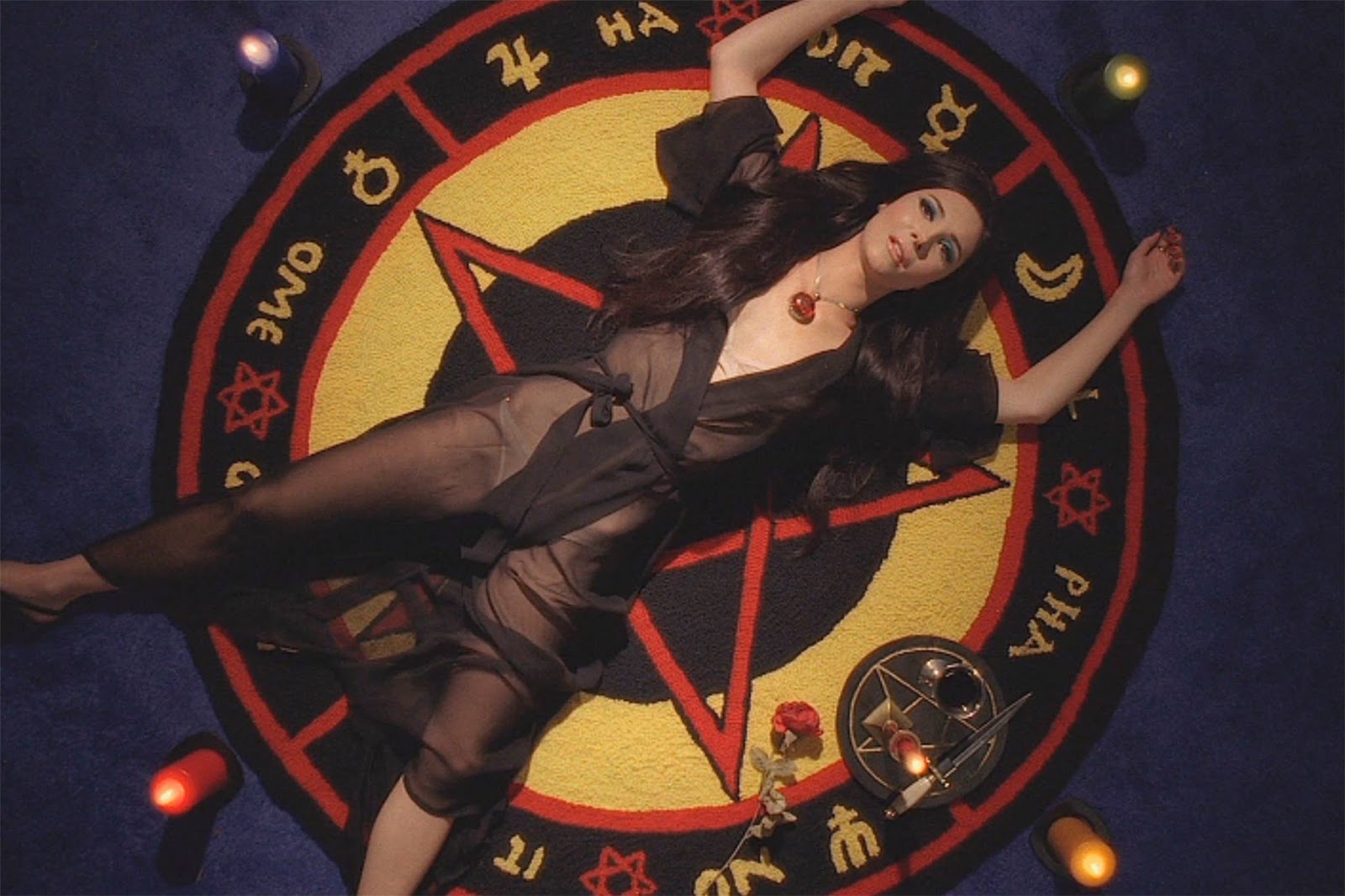
Elaine (Samantha Robinson) is addicted to love in Anna Biller's The Love Witch (2016)

It's certainly a testament to Anna Biller's incredible talent in constructing The Love Witch's rich set design and wonky period detail that until Trish (Laura Waddell) whips out a cell phone toward the end of the film, I had no real clue as to what time period in which the film is set. The opening reveals the lovely Elaine (Samantha Robinson) driving in a shiny red vintage car (with matching dress and luggage), and her voiceover only tells of her zeal to start a new life after a tale of heartbreak and emotional breakdown.  Flashes from the past show that Elaine's participation in a coven ritual has empowered her to start afresh, on a quest to experience love at its fullest.  The Love Witch is the story of that journey, and in a more significant way, the consequences that women must suffer in succumbing to the fairy tale myths about gender roles and love that are fed to them by society.

Elaine dines at the Victorian tea room with style
Period anachronisms are what give The Love Witch so much of its charm, as the film pays homage to great 70s occult films such as Girl Slaves of Morgana Le Fay (1971), Baba Yaga (1973), Hammer films such as Countess Dracula (1971) or even some Jess Franco oddity starring Soledad Miranda--although I think The Love Witch does not tap into its queer potential.  Biller's film is rather exclusively focused on hetero fantasies and nightmares (I couldn't help wishing that Trish and Elaine would end up together).  Trish takes Elaine to an incredible Victorian tea room bathed in peaches and pinks, with a golden-tressed lass strumming a harp. A seedy burlesque club hints at Blacula by way of Blue Velvet.

Elaine and Trish hang out at Elaine's witch pad
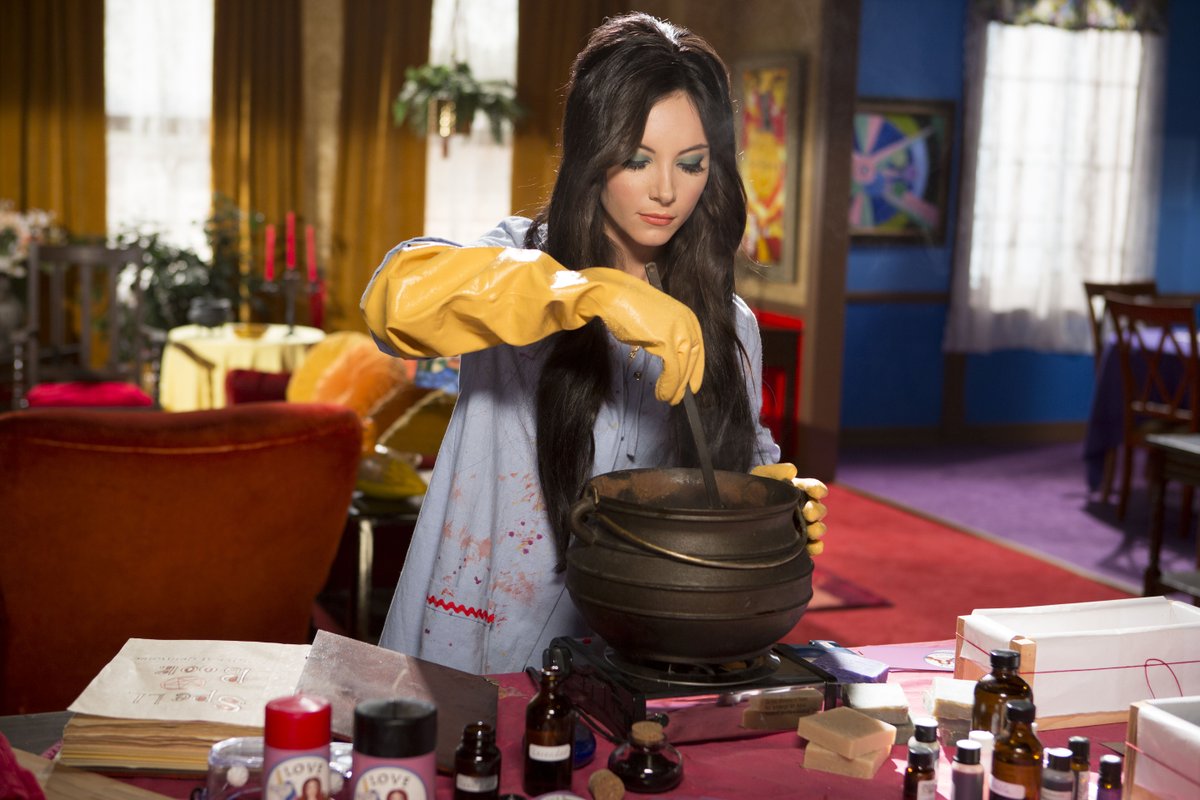
Elaine making some witch items for a local new age shop
Elaine's apartment, borrowed from her fellow witch Barbara, is filled with kitschy tarot card paintings, a cauldron, and what looks like a well-equipped laboratory spewing smoke in day-glo colors.  Here Elaine makes her love potions that she tries out on several unsuspecting men--to ill effect.  In fact, a moviegoer sitting behind me kept saying every time a man interacted with Elaine--"Uh-oh, he's dead.  He's so dead."  Poor Elaine, she isn't trying to kill anyone.  She just wants LOVE!  Another nice thing about this film--no women were physically harmed in this flick.  A rare thing, even for a horror comedy.

Elaine's bewitching gaze
Much of The Love Witch is so delightfully hyperbolic, that laughter frequently echoed through the theater.  Elaine's sensual stare, enhanced by her witch powers, is so provocative, that it stops men dead in their tracks, zapping them like deer in headlights.  There's something pleasantly off-kilter about a film emphasizing the power of a female gaze.  While the film highlights Elaine's laser interest in being the object of a presumably male gaze, she tends to frequently be oblivious to her effect on others, which speaks to some confusions that the film employs.  Is the film playing to a "male gaze" or critiquing it?

Still, many scenes just add to the overall zany tone.  One of the true standout scenes is a horseback riding date that Elaine has with Sergeant Griff Meadows, a chiseled Bruce Campbell type (without the great chin).  As they are riding through a wooded area, they hear music, and literally stumble upon a performance and feast put on by the Renaissance and Medieval Players.  They sing "Love is a Magical Thing" and it's all rainbows and unicorns (literally).  The costumes, accompanied by the music, are just too, too good!

Griff (Gian Keys) gazes into Elaine's mesmerizing eyes at their faux handfasting feast
The couple are game for a quick costume change and then a handfasting, which Elaine revels in while Griff seems to amusingly tolerate.  Biller is making fun of every fairytale cliche she can find, while also jabbing playfully at the faux witchiness of Renaissance and Medieval fairs.  The soundtrack of this film is truly, truly inspired, and Biller has her hand in every great detail.  When the harpist sings "So tra-la-la and so La-de-da" with such heartfelt sincerity, I was hard pressed not to sing along.

Elaine is every (straight) man's fantasy, but is clueless about her own desires
Unfortunately, or maybe fortunately, all this lightness is tempered by a rather dark heart.  At the film's beginning, Trish rightly calls out Elaine for some of her truly backwards beliefs, exclaiming "It's like you've been brainwashed by the patriarchy!" Both Elaine and her coven friends espouse the idea that women gain their power through their sexual wiles, but this power is limited only to a certain kind of glamorous, and largely unfulfilling seduction.  Elaine's head is so filled with notions of fairy-tale romance and an obsessive, overpowering love, that she gains little satisfaction from the elaborate steps she takes to secure the desires of the men around her.  In fact, she is so "brainwashed" that an entire scene shows her getting off to a chorus of emotional and verbal abuse spewing from the mouths of countless men, her father seemingly included.

Star (Elle Evans) and Moon (Fair Micaela Griffin) dancing very poorly at the burlesque club
The Love Witch had a few confusing missteps that muddy its message a bit.  The film does no favors for witches, suggesting (albeit hyperbolically) that these goddess worshipers are just perpetuating a rigid gender binary, and that they are only interested in fulfilling narrow narcissistic desires in a quest to bend the world to their will.  Instead of empowering the impressionable Elaine, her coven pals only seem to lead her toward her inevitable doom.  While the film seems to criticize the limited range of power that a woman's (hetero) sexuality elicits, scenes highlighting Elaine's wide variety of scrumptious lingerie are notable and numerous.  Further, the film is almost entirely narrated through Elaine's voiceover (yes, she's pretty unreliable as narrators go), but toward the end of the film, the narration suddenly switches to Griff.  Griff's thoughts emphasize that he's a complete cad, but I felt that this shift in narrative authority dis-empowers Elaine in some unfortunate ways.

Elaine rides off into the sunset with her fake prince and fake unicorn
When Elaine realizes that Griff is not her fated true love, she shatters, forever slipping into the fairytale world where she ultimately gets her prince (and her unicorn).  Alas, that world is both unreasonable and impossible for women fueled by such ridiculous fantasies, and the only recourse for Elaine is madness.  Anna Biller's The Love Witch is funny and entertaining, but ultimately supplies a sobering message to hopeless hetero romantics bent on getting their man.

Tuesday, August 28, 2012

Happy Birthday Man Ray!


So the fascinating avant garde photographer and artist Man Ray would have been 122 years old yesterday, but alas he's dead.  I've got to hand it to the Huffingtonpost, they are prolific with the puff pieces regarding long dead artists--mostly famous white guys (Gaudi, Buckminster Fuller, Hitchcock, Man Ray).  Still, these pieces do stimulate me to post on these icons long gone.

Emmanuel Radnitzky was born in Philadelphia and then, as an early hipster, lived in Williamsburg, Brooklyn with his family.  In the face of anti-Semitism, the family changed their surname to Ray, and Emmanuel shortened his nickname "Manny" to Man.  He moved to the city, befriended Marcel Duchamp, was inspired by the famous Armory Show of 1913, and then he and Duchamp became full-fledged Dada-ists, especially after moving to Paris in 1921.  Here are two of my favorite Man Ray "readymades:"

Cadeau 1921

Object Intended to be Destroyed 1923

As one can see, both of these manipulated objects strike a discordant note, as they veer sharply from their utility to become something strange and other.  These works certainly adhere to the famous Comte De Lautremont quote, "As beautiful as the chance meeting on a dissecting table of a sewing machine and an umbrella."  The combination of the disparate elements Man Ray uses creates something new, an object both familiar and unexpected (the very definition of Ernst Jentsch's "Uncanny").

In a sense, Man Ray's pictograms, which he called "rayographs," stem from a similar notion of rendering the familiar strange.  He would place objects on photographic paper and then expose them to light.  Once the images are developed, objects maintain links to their referent, and are quite indexical, yet these objects are transformed rather than captured.  Many of these rayographs are pretty whimsical as well.

Rayograph 1922

Rayograph 1923

Rayograph 1926

Man Ray was also known for his re-discovery, and prolific use of the solarisation technique, where white light is flicked on during the development process and effectively burns/solarises the image, creating a very unique effect.  Rumor has it that his muse and lab assistant, Lee Miller, really re-discovered this process by accidently turning on the lights when processing the film.  Something had crawled over her foot in the darkroom.  Inspiration can come from mice in the dark!

Lee Miller 1930

Solarisation 1931
I became interested in Man Ray and his crew in the early 1990s, when I was getting my MA in Cinema Studies at NYU.  I was taking this class with Annette Michelson called "Dada/Pop/Surrealism;" me and about 60 other students.  NYU was a real degree mill for Masters students back then, so our graduate seminars were really huge.  Michelson didn't know I existed, but I was in awe of her.  Her lectures were mind-blowing, and she actually hung out with people like Man Ray and Duchamp.  In the notes on her lectures, I would always write things like "Wow," and "Amazing."  She was so incredibly inspiring and compelling.

In her class, I wrote a long paper about Man Ray's photography and films in relation to gender and representation.  I was fascinated by the way in which women and objects were both rendered uncanny and equivalent.  Unfortunately, Professor Michelson was not that impressed--"B+"  Here are some of the images that inspired those passions and questions:

Le Violon d'Ingres 1924

Noire et Blanche 1926
Woman with Long Hair 1929
Prayer 1930
Also, here is his most evocative film, L'Etoile de Mer (1928)