Showing posts with label Queer films. Show all posts

Monday, July 10, 2023

Review--Huesera: The Bone Woman--Michelle Garza Cervera (2022)


   The baby causes grave consequences in Huesera: The Bone Woman (Michelle Garza Cervera, 2022)

First off, a warning:  If you hate the sounds of knuckles cracking, and bones breaking, that snapping sounds that makes one flinch, then this film is not for you.  I'm just pointing out one of the chief ways that horror is produced in Huesera: The Bone Woman (2022).  Pregnancy horror has been a hot horror topic for quite some time, including everything from Rosemary's Baby to the recent 2021 film False Positive, but Michelle Garza Cervera's debut film provides a unique perspective on the topic.  The film has many of the common tropes--unsupportive family members, insensitive partners, tone deaf medical practitioners, a woman alienated from her own body--but it views these challenges in a woman's life through a queer viewpoint.  The film is not only a deeply empathetic character study of its protagonist, Valeria (Natalia Solian), but also mixes in Mexican folklore to create a truly chilling portrait of the ambivalence, depression, and despair many women feel when they are compelled to fit into a heterosexual world and its restrictions--including having a child.

Raul (Alfonso Dosal) only treats Valeria (Natalia Solian) with impatience as the film evolves

Valeria is married to Raul, who works in advertising, and she's trying to get pregnant, with the usual après sex legs-up calisthenics common to this desire.  Their married sex is very perfunctory.  She actually prays to the Virgin Mary with her mother in order to achieve this goal, and lo and behold, she's pregnant. What so few women realize is that in both Mexican and U.S. culture, childbearing and rearing are what women are supposed to do, and they are not fully prepared with the loss of individuality and the push toward conformity that motherhood entails.  In flashbacks, viewers discover that Valeria was once a free-wheeling punk in a queer relationship, preparing to leave town with her girlfriend, Octavia (Mayra Batalla).  With the sudden death of her brother, Valeria makes the choice to stay with her conservative family, instead of escaping the expectations that confine her.  She has made the choice to make her family proud by marrying a man, and conforming to the heterosexual life that her family demands she have.  The tensions around her queer sexuality come across in numerous jabs and insults that her parents and sister hurl at her, reminding her of some babysitting accident in her past that taints her, and just telling her to suck it up as she struggles with her new condition mentally and physically.

                     Valeria's sneaking of a cigarette will soon be punished beyond imagining

As a young, fledgling furniture designer, she makes unique furniture, but is told by her doctor that she should quit, because of the fumes.  Soon she's left home alone, and bored, while Raul is off to work.  One evening, upon waking, she sneaks a cigarette, only to watch a woman across the way, climb on top of a balcony and jump.  Yet, when Valeria looks at the ground, the woman slowly rises, her bones cracking as she stumbles upright, her body unnaturally shifting and moving in a jarring manner.  Raul convinces her that it's all a dream, but it isn't, and watching everyone gaslight Valeria and think that she's crazy is a bit frustrating.  The film implies that watching this death has tainted her, and dark magic must be used to help her escape from the horrors that consume her, and her newborn daughter.

                   Valeria's journey to motherhood and beyond affects her body significantly

The Mexican folklore that the film employs is fascinating.  Here's a summation of the legend from a Nerdist review of the film: "The film’s title itself stems from the legend of La Huesera. This Mexican myth is about a woman who collects animal bones—specifically from wolves—until she has a complete skeleton. She sings life into those bones, bringing the creature back from another realm. It runs free towards an open horizon, sometimes transforming into the shape of a woman. The bones represent the life force within us that doesn’t want to be tamed. And La Huesera seeks to restore what is lost." This folklore translates perfectly into Valeria's despair over her now "tamed" life, for she has chosen to conform to the expectations that Raul and her family have for her.  She repeatedly escapes, to the punk clubs and to Octavia, to experience that untamed freedom once more.  While Raul shies away from having sex with Valeria after she conceives, proclaiming a fear of hurting the baby, she finds someone comfortable with her body and desires when she visits Octavia.  Their relationship is loving, supportive, and buoyed by their shared desires and understanding. 

Valeria goes to some brujeria to help free her from the Bone Woman's influence

While some spectators might be disappointed by the relative lack of blood and gore in the film, cracking bones and writhing bodies are certainly unnerving, and the hallucinatory events that occur once Valeria visits the brujeria are both beautiful and revelatory.  I found myself completely invested in Valeria's emotional landscape, and I also found the ending very satisfying and fair.  Not everyone might agree, but the struggle between her desires and everyone's expectations that Valeria undergoes is concluded without any real plot holes, and is also distinctly sympathetic and supportive of her queer identity and her desire for her daughter's health and happiness.  Huesera: The Bone Woman is currently streaming on Shudder.  I highly recommend it!

Thursday, July 16, 2015

Tangerine--Sean Baker (2015)

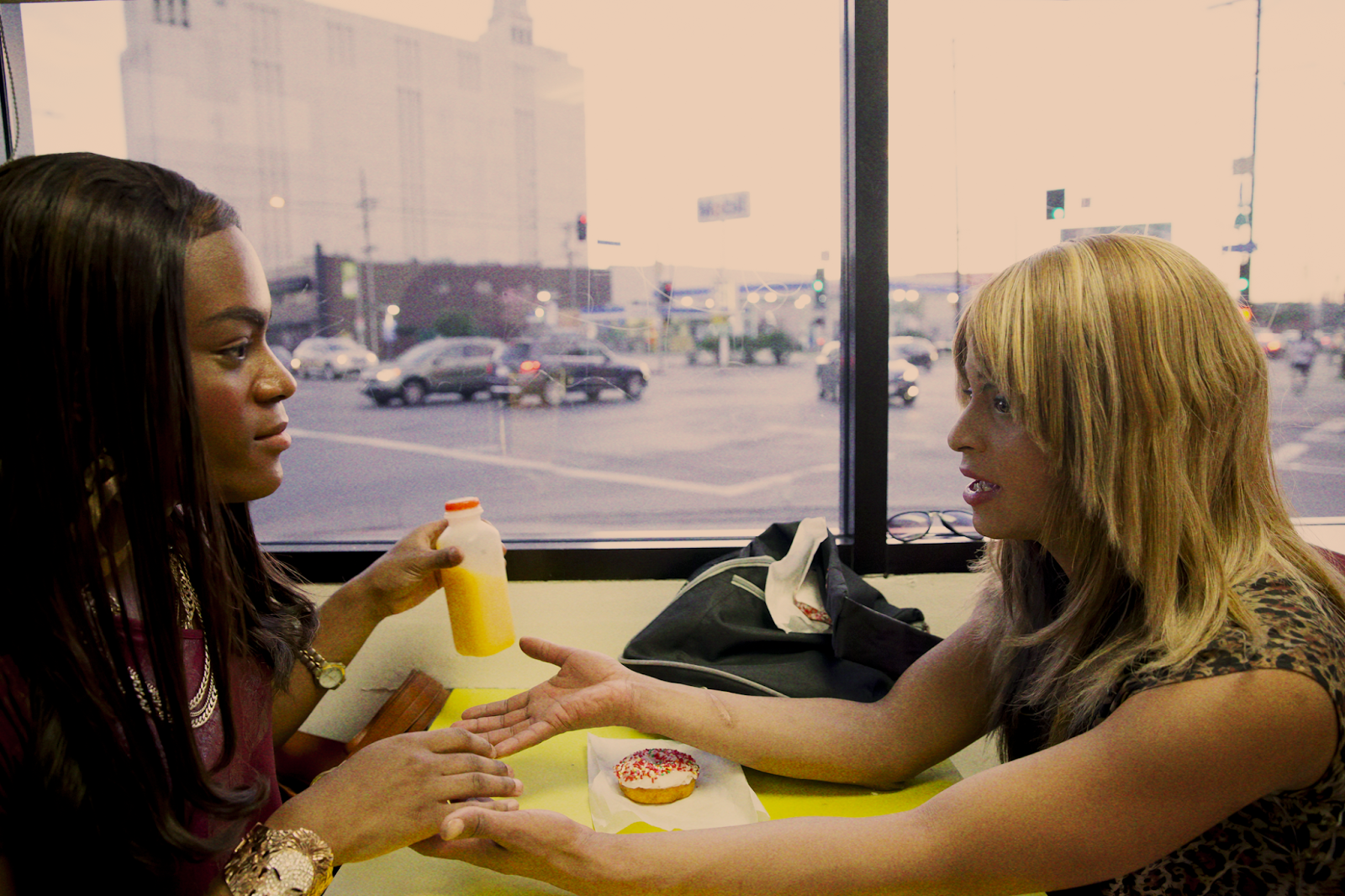
Alexandra and Sin-Dee in Tangerine--Sean Baker (2015)
Montreal is a city full of cinephiles.  Opening night of the Fantasia Film Festival 2015 in the Salle J.A. de Seve, and people are lined up patiently to see the darling of Sundance, Sean Baker's Tangerine, a film chronicling the adventures of two transgender women prostitutes and an Armenian cabbie in West Hollywood on Christmas Eve.  On paper, that description wouldn't necessarily have people lining up in droves.  Yet the film is full of sweetness and wit, even in its zaniest moments as the camera propulsively follows Sin-dee (Kitana Kiki Rodriguez) across L.A. on a mission to confront her man, Chester, who has cheated on her while she spent the last 28 days in prison (copping to his possession charge).  Her fellow trans sex worker, and best friend Alexandra (Mya Taylor) lets this information slip out in the first 2 minutes of the film, and from then on the "drama" never stops.  Sin-dee and Alexandra's day is interspersed with Razmik's (Karren Karagulian) experiences as he picks up a variety of eccentric fares.  As the day goes on, viewers discover that Razmik and the ladies' paths intersect in significant ways, culminating in an epic showdown in a donut shop.

Sin-dee finds her cheating fish, Dinah (Mickey O'Hagan)
I admit, I was worried about Tangerine despite all its glowing hype.  A white guy makes a "funny" film about poor transgender prostitutes of color--the possibility for stereotypes and caricatures just overwhelms my mind.  The fact that Baker cast Rodriguez and Taylor, two actual transgender women of color, is a point in the right direction.  The film is funny in a witty, wisecracking manner, but counterbalanced by some thoughtful poignancy.  For a good portion of the U.S. (and elsewhere), Christmas eve is a time of family gatherings, gift giving, and good cheer.  Just as many people experience the holiday as just another day of work.  Where Tangerine really finds its heart is in how some beautifully crafted characters experience family as something a person makes rather than a community into which they are born.

Just another night in L.A.
Baker shot the film entirely on an Iphone 5, giving the film a sense of intimacy that hints at Dogme filmmaking. That slick video blur really serves the film best when in the heat of the action as the camera chases after Sin-dee traversing the city, on its streets and many forms of public transportation.  That feeling of proximity is also especially intense in Razmik's cab, as he converses with his fares, or has a memorable encounter with Alexandra in a car wash.  The soundtrack is also really striking, ranging from hip-hop to classical in a masterfully cut parade of image and sound.  I've heard some complaints about the jump cuts, but I think they are a perfect way to give the film its lively energy.  Well worth seeing, but not as mind-blowing as the hype suggests.

Lake Mahar--Julian Yuri Rodriguez (2015)
The fun of Fantasia is the shorts programming that tends to surprise you when you least expect it.  I forgot that so many of these films open with a short, usually one that is carefully programmed along with the feature.  Lake Mahar was really, really nuts.  A little stilted, kind of gross, and check out the blurb on the Fantasia site: "The King Arthur legend is adapted to become a nightmare of Caucasian emasculation on Miami's Flagler Street as one man's family threatens to be torn apart by invaders from all sides."  Really??  I definitely got the white masculinity in crisis part, but I must have missed something.  Maybe the "snail meningitis" was catchy.  The female characters made my skin crawl, which is never a great sign, and white guys always seem to be in crisis.  Please.