Showing posts with label folk horror. Show all posts

Monday, July 31, 2023

Review--Nocebo--Lorcan Finnegan (2022)


             Nocebo (Lorcan Finnegan, 2022) even manages to make Eva Green ugly!  Hard to do.

Many people do not take horror films seriously, and just think they are dumb fun without anything really socially relevant to say.  Further, those kinds of films rarely get Oscars, which isn't the only way to judge a film, but it is a way many people align films with their worth.  Sigh.  Sure, some films are more overt about their socially conscious message, but horror films have important things to say about our fears and anxieties, as well as how those fears shape our world.  Most horror makes us fear through the process of "othering," rendering characters who might seem different and strange as monstrous.  Nocebo, Lorcan Finnegan's newest film after Vivarium (2019) goes back to his Folk Horror focus, initially represented in his first feature Without Name (2016).  While I haven't seen either of his previous films, a film starring Eva Green will always be in my "to see" list, especially if it's a Folk Horror film.  Win!!!  Finnegan's film is an astute exploration of inequality and revenge, and once you get to film's end, the message is damn clear.  viewers should be thinking more deeply about where their clothing comes from, and who makes them...but I'm getting ahead of myself.

  Traditional medicine seems to fail Christine, for her symptoms disappear every time she sees a doctor

The film is set in both Ireland and the Philippines, making this work a solid coproduction.  Spectators are first introduced to Christine (Eva Green) while she's at work.  She's a children's fashion designer, and she's putting on a runway show for her latest designs.  Having to take a phone call, we only see her side of the conversation, but she appears deeply upset and says "pulling out bodies" at one point.  Ruh-roh.  My first thought was that either her husband, Felix (Mark Strong) or her daughter Roberta, aka Bobs (Billie Gadsdon), have been in a car accident.  This narrative move seems to be more and more common in horror films with female protagonists.  While Christine is on the phone, a mangy looking dog walks into the showroom, and slowly shakes itself all over Christine, showering her with ticks.  Yeah, it's nasty, but we never learn what the phone call is about until much, much later.  Cut to eight months later, and Christine is a shadow of her former self, with a mysterious ailment that she cannot seem to shake.  Her symptoms weirdly disappear every time she goes to the doctor, and thus Felix thinks it's all in her head--of course he does, because the unsupportive and suspicious spouse is the go-to in horror films that focus on women protagonists.  Then her savior arrives, the lovely and enigmatic Diana (Chai Fonacier).  Because of Christine's frequent memory lapses, she's not at all phased that she has forgotten she's hired Diana, a Filipino woman, to take care of the house and her daughter.

          Diana (Chai Fonacier) employs folk practices to help heal Christine's various ailments

Chai Fonacier as Diana is a force of nature in Nocebo, literally and figuratively.  She arrives, claiming to be there to help Christine, and she does so, using various folk traditions and practices to pull the sickness out of her.  She's a bit mysterious, though, with a shrine set up in her bedroom that she hides away from her employers, and a pile of ash that she leaves in front of her bedroom door--one that a child's footprints are nestled in.  Christine grows more dependent on Diana as time passes, and even Bobs becomes increasingly close to her gentle kindness.  Yet, what is she hiding?  Certainly Felix is extremely suspicious, and feels like he's in an emotional tug of war with her over Christine's well being.

               Diana, as a child, being possessed by the Ongo--one that gives her great powers

Diana eventually discloses to Christine that her healing powers come from her possession by an Ongo, whose powers were passed to her as a young girl when the Ongo originally passed in her childhood home.  Now, Diana has the ability to heal, and to also cause great harm.  Like any good Folk Horror, the cultural clash between this rich, white, privileged family and a poor woman of color struggling to make money determines much of the film's conflict.  Viewers discover later, through flashbacks to the Philippines, that Diana used to work in sweatshop eking out fast fashion in a Philippine city, and her daughter, who she was forced to bring to work with her, perished when a fire erupted in the warehouse.  Crucially, **spoilers moving forward, Diana was making clothing, children's clothing, for Christine.  Once viewers think back to the film's instigating incident, and the start of Christine's mysterious illness, the urgent phone call she takes at her fashion show is news of her workers perishing in this fire.  They were harmed because they were 1) forced to work in unsafe conditions, 2) asked to increase their quota of garments significantly, and 3) locked into the building in order to prevent them from stealing--something that Christine specifically makes a policy.  Diana's long game is revenge.

    Diana's rituals escalate as she "helps" Christine to understand her complicity in her daughter's death

Christine's husband Felix was suspicious of Diana from the start, but Diana expertly uses Bobs as a way to cast doubt on his trustworthiness, asking her to lie in order to turn Christine against him. Then a fortuitous fall over the bannister lands Felix in the hospital, and Diana conveniently steps up her treatment of Christine's illness, including having her slave over a sewing machine in intense heat and without breaks.  While I'm not going to give a way the film's ending, it's pretty damn satisfying.

                           Bobs, as the new Ongo, collects valuable herbs in the forest

Nocebo is unique for its clever mixture of occult and supernatural rituals--with a specific Philippine focus--as well as its frank and powerful indictment of white privilege, fast fashion, and sweatshop labor.  While I do love Eva Green, her character Christine is pretty hard to like by film's end, and her fate seems fair for the crimes she, however unwittingly, commits.  A comment by Diana, that she'll always be with Christine's daughter, Bobs, plays out as true and rather poignant, as viewers witness in the film's final images the young girl communing with the nature that surrounds her.  Finnegan's work here actually makes me want to give Vivarium a try!  Nocebo is currently streaming on Shudder, and highly recommended.

Wednesday, July 12, 2023

Review--The Twin--Taneli Mustonen (2022)


           One Creepy kid (Tristan Ruggeri) and Finnish folks with dorky hats are in The Twin (2022)

I was really, really digging The Twin (Taneli Mustonen, 2022) through most of its run time!  Then came the film's ending, and I was so outraged.  Outraged!  

Sometime in the 1980s, Rachel (Teresa Palmer) and Anthony (Steven Cree) are struggling with immeasurable grief, as they lost one of their twin sons, Nathan, in a car accident.  Haunted by this incident, they leave New York City with their son, Elliot, in tow, and travel to Anthony's homeland, a small village in Finland (it was actually shot in Estonia).  The majority of the film takes place here, as the couple and their son hastily move into a giant house in the Finnish countryside in order to start anew.  The house in which the film is set has multiple floors, and seems to be the setting for a former funeral home or mortuary?  It's kind of unclear.  Elliot immediately decides to live at the very top of the house, in the attic, with a super sinister round window at the top, and asks that Mom and Dad put a twin bed in for his dear, departed twin.  Rachel acquiesces to his request, while Anthony immediately pushes back, suggesting that this situation is exactly what "the doctor" warned against.  This set up easily slides into the Haunted Heroine horror film, where a female protagonist struggles with seemingly supernatural events, while everyone else--the local folk, Anthony, and even Elliot--actively question every single move that Rachel makes.  Yet, there's a ton of creepy stuff afoot.

                       Rachel and Elliot cling to each other in the menacing Finnish forest

First, the family visits a local pagan shrine, where if you press your hand against the red handprints on the rock, and make a wish, your wish very well might come true.  Elliot proceeds to "make a wish," and you just know he's wishing for his brother's return.  Then at a welcoming party that the family attends, everyone seems to ignore Rachel, except for the elderly Helen (Barbara Marten), who the villagers believe has a screw loose.  She pulls Rachel aside and tells her that she dreamed of her, and that her son has made a wish, and it was granted.  Ruh-roh.  Not only is Rachel not fitting in, but she and Anthony are compelled to climb onto some giant wooden "wedding" swing as another "pagan" tradition of the town.  As the pagan traditions start to add up, I was getting really excited about a potential Folk Horror title to add to my very long list.  Helen appears to be the only person really willing to talk to Rachel, or take her seriously, especially when Elliot disappears, and then comes back, claiming that he's Nathan.  Sure, Helen equates pagans with Satanists, which is rally sloppy for 2022, but I went with it.

               Rachel, dressed up as some May Queen, is tended to by a bunch of nuns/cultists?  

The strange folk of their new town are rendered stranger at every turn.  At first, they stand around silently, looking disapproving and whispering behind Rachel's back.  Then her visit to the doctor about Elliot's claims (that he's Nathan) just serves to piss her off.  Helen then brings up a cockamamie story about her husband being possessed by some demon, his face twisted into an obscene grimace as he dies a pretty awful death.  There's even one scene that juxtaposes Teresa's weird nightmares/visions with Helen's to suggest that these two women are struggling within a foreign environment (Helen is British) intent on destroying them.  At this point in the film, like Rachel, viewers do not trust anyone, especially Anthony, who comes from this pretty grim place.  Helen also suggests that there are some weird town-related conspiracies involving circles, and we then see numerous rituals on bleak hillsides, where the strange folk are standing in circles, doing who knows what.

                                        Rachel looks pretty awesome in mourning garb

If not for Teresa Palmer's persuasive portrayal of Rachel, this film would be dead from the start, but she's so convincing, that viewers care about the stakes here.  The husband and son are not very well-developed, but after they move to Finland, Anthony comes across as a gaslighting mastermind, who has the whole town convinced that Rachel needs medicating.  In fact, there are numerous shots of Rachel waking up in bed after being dosed with a hypodermic.  What are these people up to, you wonder, as clumps of townsfolk stare, and stare at her.  As I said, the explanation jettisons all the potential Folk Horror/possession/haunting possibilities.  **SPOILERS FOLLOW Turns out, according to that jerk, Anthony, that he and Rachel never had a twin, that Nathan died in a car crash where Rachel was driving, and that she's just crazy, hallucinating another twin when there isn't one.  Oh, and Helen's clearly crazy too, just as the rest of the town thinks she is.  Sure, the Haunted Heroine narrative always oscillates between supernatural happenings and unreliable narrator madness, but something about The Twin felt cheap and dirty in choosing to end the film this way.  Leaving the cemetery one last time, with her family's two gravestones in front of her, Rachel climbs into her car to discover that EVERYONE'S ALIVE, including the imaginary twin she created.  Basically, the ending completely negates all of the spooky stuff happening throughout the earlier portions of the film, rendering any supernatural questions pointless.  The "it was all just a dream/delusion" finale does not feel earned, and I'm still angry at the bait-and-switch.  Perhaps the "she was always just insane" approach has worn thin for me, but The Twin, now streaming on Shudder, disappoints.  NOT recommended.

Sunday, July 2, 2023

Review--Unwelcome (Jon Wright, 2022)


After a brutal home invasion, Jamie (Douglas Booth) and Maya (Hannah John-Kamen) move to Ireland

As I'm working on a book on Folk Horror television right now, I'm always eager to watch anything that might be categorized as Folk Horror.  Jon Wright's Unwelcome (2022) is a demented little film that I really enjoyed, as it combines home invasion, folk horror, and creature feature into a fun package.  Yes, I'm "spoiling" the film a bit by highlighting the home invasion in my caption, but this break-in provides the motivation for Maya (the always fabulous Hannah John-Kamen) and Jamie (Douglas Booth) to move into his Aunt Maeve's place in rural Ireland.  A helpful neighbor, Neve (Niamh Cusack) impresses on the couple that Maeve practiced "the old ways," and that she left a blood offering for the Redcaps nightly, in order to satisfy their hunger.  When Maya takes this information in, she finds it quaint and rather silly; she's a Londoner, so she has no clue what Irish folklore--and stories of the far darrig--might entail.  Of course, all this "discussion" gets viewers primed for the Redcaps, and inevitably, Maya forgets to put out an offering, so....

 The Whelans at work--Eion (Kristian Narn) and Aisling Whelan (Jamie-Lee O'Donnell) cause trouble

Since Maya and Jamie have a huge hole in their roof, amongst other home repair issues, they hire a local Irish family, The Whelans, to do the repairs.  Led by "Daddy" Whelan (Colm Meaney), this bunch are stereotypically scary country folk who harass the new homeowners at every turn.  This rough bunch come across as shockingly similar to the home invaders that attacked the couple at the film's beginning, and the locals are not fans either.  The Whelans bring the necessary conflict to make the heavily pregnant Maya even more terrified in her new home.  Thus far, the supernatural elements seem less threatening than the Whelans.

Maya lets her curiosity lead her into the land of the fae, behind an ancient wooden door.  Here she finds a mystical forest, and an underground series of tunnels.  She also happens to encounter Eion Whelan (Kristian Narn), an abused son of Daddy, who takes a liking to Maya and her kindness. As soon as spectators think that Maya and Eion are bonding, he takes things too far and Mays screams for help.  Suddenly and brutally, Eion is pulled off of her, and she tears out of there, running in terror back to her home.

              Maya's curiosity compels her to explore what lies behind the old cottage door

Once Jamie returns home, he finds Maya terrified, recounting the story of what happened in the forest beyond the door.  Jamie doesn't believe her, and goes off to the pub, thinking she has "baby brain."  While he's away, she has a visitor.

                                        A Redcap visits Maya while Jamie's away

The film takes a rather drastic tonal shift once we see the Redcaps for the first time, as they are rather hilarious in a Jim Henson kind of way, rather than a terrifying way...until they bring Maya a gift--Eion's head in a plastic bag.  That's around the time when the film goes bananas, and pretty much stays that way until the very end, with gallons of bloodshed, a surprise birth, a trip down to the Redcaps cave, and the anointing of a new leader for the Redcaps to worship and revere.  Makes you want to move to rural  Ireland immediately. NOT.

                                                      Blood rains down on Maya

While Unwelcome hits many familiar notes, it's the Redcaps that keep you glued to Maya and Jamie's struggle.  The film is equal parts menacing and goofy, making for a relatively light-hearted, fun watch in the end.  It's not particular frightening, but horror doesn't always have to be, especially when a film deliberately injects comedy into its veins.  Definitely worth a watch.  Unwelcome is streaming on Shudder right now.

Friday, June 23, 2023

Review--Consecration--Christopher Smith (2023)


As a someone who was raised Catholic, I think almost all religious films, and religions, are scary.  My take is that Catholicism is a cult just like any other, and the Pope and his cadre of guys are the cult's leadership.  I'm also a pretty big fan of Jenna Malone, the star of Christopher Smith's latest horror thriller, Consecration (2023), so ignoring the disappointed and disappointing reviews of the film, I jumped right in.

         Grace (Jenna Malone) is a hardworking ophthalmologist trying to help her patients 

In the first few minutes of Consecration, Grace is walking down a London street when suddenly a nun in a pristine white habit points a gun at her...fade to black.  I like this beginning.  Call me intrigued and ready for more!  Switching to the present day, Grace is meeting with a blind woman and her husband, and suggests that there is a way to bring her sight back.  She then receives a phone call that her brother, a priest named Michael, was involved in what the police believe is a murder/suicide at a Scottish convent.  Grace doesn't believe that Michael could kill someone, let alone himself, and goes to the Mount Savior Convent on the Isle of Skye to investigate.  Cue sweeping vistas and sky-high seaside cliffs, as well as some really lovely drone shots of driving through the scenery.  Stunning.  The film actually reminds me of Mariano Baino's 1993 Nunsploitation shocker Dark Waters, with equally weird and malevolent nuns and just a touch of Folk Horror.  

              Grace sees the body of her brother Michael's body (Steffan Cennydd)

Grace is not buying the story the nuns are giving to the cops, particular DCI Harris (Thoren Ferguson), who is in charge of the investigation.  Why isn't there sand all over him if he died on the beach, she asks.  Well, Mother Superior and her mysterious fellow nuns are definitely hiding something.  Also on the case is Danny Huston's Father Romero, sent by the Vatican to consecrate the church and deal with a missing relic situation.  He appears to be helping Grace, but one scene gives away the game when Grace is not present.  Of course, as a Vatican "enforcer," he's not to be trusted.  He provides Grace with a book in secret code written by her brother--one that only she can read.  Kind of cool.  Lots of religious talk about there being "one true God," etc.  Again, like Dark Waters, viewers are not quite sure what God that might be, since the practices by the nuns are rather strange.  

Upon reading her brother's coded journal, Grace starts to experience a stream of confusing visions and hallucinations.  She has a very strong connection to Michael, in life and death, and not only does his spirit warn her, but she "sees" his torture by a priest and nuns when she touches an area where he has been.  What gradually unfolds is a traumatic past full of religious zealotry, child abuse, and children kept in cages.  Further, when the two children are on the way to being adopted after their mother's death by their father, a priest boots little Michael out of the vehicle and tries to chloroform Grace.  Things do not go well.  She also has strange flashbacks to experiences a century ago, where she's a little girl wearing a weird mask, and worshipping some deity above.  Definitely some folk horror practices going on.  Time bounces back and forth without clear boundaries, as Grace seems to see things from the past and the future.  No wonder in adulthood, Grace turned to science, while Michael fell deeper into religion.  Now, it seems there's a reckoning, as Grace investigates the secrets the convent is hiding, and how they connect to a traumatic past she is eager to forget.

                  Mother Superior (Janet Suzman) believes that the "relic" is Grace herself

Throughout the film, Grace is progressively stripped of her independence, as the convent places more and more restrictions upon her.  Also, nuns seem to end up dying right and left, by their own hand.  One minute they are brandishing a scary knife.  The next, they are dead.  Grace becomes more and more frightened as she watches these "murders" unfold, and the cops are highly interested in her.  Strangely, DCI Harris, when faced with these strange occurrences, steadfastly thinks it's all hooey.  Despite the occasional moment with another character, for expositional purposes, viewers are never far from Grace's side, and we are consistently meant to identify with her as she investigates these mysteries.

                         Grace begs Father Romero for help, surrounded by nuns

One of the penultimate showdowns between Grace and this cult is quite a spectacle, and the choreography of their religious rituals is definitely one of the visual highlights of the film.  Father Romero keeps saying "my child" to Grace in the most disingenuous way, but based laid cult plans!  I have to say, when viewers start to get answers to what's going on, I thought, "Oh. That's really dumb." Yet, you cannot just accept the film's "conclusion" at face value, because there are two, count them, two explanatory codas, that make spectators question everything that came before.  Like his previous film, Triangle, Consecration is certainly twisty, with some last minute reveals that sometimes hit and miss. Still, the nun with a gun comes back, and the very last death in the film is kind of great.  Sure, the death is a little cliché, but for me, that particular jump scare never gets old.  Consecration is not a great film, but it's pleasantly watchable, with a good performance by Jenna Malone, and a bunch of creepy nuns.  If you find religion terrifying, this film will hit some of your sweet spots.  It's streaming now on AMC+.

Thursday, July 4, 2019

Ari Aster's Exploration of Grief--Midsommar review (2019)

Dani and Christian take a solstice holiday in Ari Aster's Midsommar (2019)
I had the good fortune of seeing an Ari Aster double feature last night, with a re-screening of Hereditary (2018) accompanied by the premiere of Aster's second feature film, Midsommar (2019).  On the whole, I'm a fan of Hereditary, and watching it again, I unsurprisingly noticed more details and became more sympathetic to the grief-stricken Annie and her family than I was the first time I saw the film.  To some extent, Annie and Charlie are mere victims of a group of people "hellbent" on maintaining the patriarchy by bringing this low-level demon, Paimon, into the world.  Toni Collette is still mesmerizing in her grief, and I really started to sympathize with Alex Wolff's Peter in a much more visceral way this time around.  Wolff gives an extraordinary performance.

I also got into a bit of an argument with this guy sitting next to me, who kept insisting that Annie is entirely unreliable, and the only character worthy of our identification is Steve.  Of course, I think Steve (Gabriel Byrne) is by far the lamest character in the film, just politely downing some pills with his scotch rather than actively doing anything of import!  Yeah, I still dislike that character, but the guy next to me swore that Steve is the only one who actually knows how to grieve, and he's the biggest victim, mostly of Annie's machinations.  Please.  I didn't stick around to hear his take on Midsommar, but I bet he didn't like it that much, since spectators are yet again compelled to identify with an "unstable" female protagonist.  If he was trying to cling to some male POV, then he's pretty SOL unless he identifies with the wonderful Pelle (Vilhelm Blomgren) who is always, always on protagonist Dani's side.

Dani (Florence Pugh) is the heart of Midsommar and we are aligned with her POV
Ari Aster is capable of bringing out these incredible performances from his female protagonists, and Florence Pugh's Dani is a revelation.  Her journey is ours.  I happened to encounter Pugh in Carol Morley's wonderful The Falling (2014)--her breakout role--and while we do not get enough of her character in that film, one can understand why the other girls, including Maisie Williams' Lydia, are obsessed with her.  Initially, Dani is painted as insecure, tiptoeing around her boyfriend Christian's (Jack Reynor's) delicate feelings, concerned that she might scare him away.  She beautifully embodies this giving and generous woman who chooses a bro who doesn't really appreciate her.  In fact, Aster makes it a point to represent Christian and his bro friends, Josh (William Jackson Harper) and Mark (Will Poulter) as dickheads, with Pelle standing out as someone who is especially sensitive and kind in comparison.  Pelle has invited the guys to his Swedish village's Midsommar festival, and after Dani suffers an incredible tragedy, Christian reluctantly invites her along.  Grumble, grumble say the bros, especially Mark, who clearly just wants to get laid by some beautiful Swedish women.

Christian, Dani, Josh, and Pelle observe the beginning of the 9 day feast and its accompanying rituals
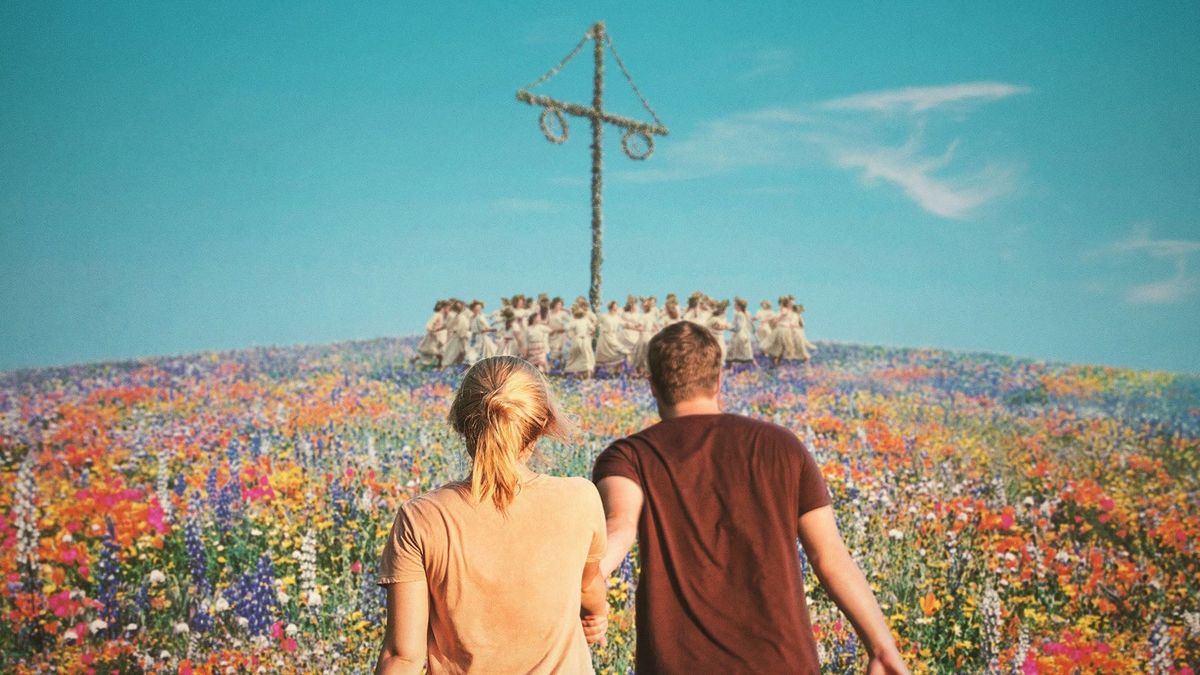
I'm a huge fan of folk horror--HUGE!  So the elaborate occult rituals and all the details involved in this special solstice celebration--one held every 90 years according to Pelle--gave me such pleasure.  Sure, there are moments that seem pretty over the top and hearken back to Robin Hardy's The Wicker Man (1973) big time, but Aster really doesn't handle any of these ritualistic scenes in quite the same exploitative fashion as the earlier film.  In fact, the pagan rites--intertwined with notions of nature and community--seem no less strange than a variety of different practices which are a part of "acceptable" religions; which, I believe, is exactly Aster's point. Christian and Josh, anthropology doctoral students, see the commune as alien, something to be studied and investigated, and do not really perceive the inhabitants as human.  Don't even get me started on Mark, who Aster unfortunately caricatures as this unenlightened neanderthal horndog. Yet, as the film really is filtered through Dani's perspective, her attitude toward the commune and her fellow American guests, gradually, but assuredly, evolves.  Our experience of the film as "horror" largely depends on if our perspective changes along with hers.

Some of the Midsommar rituals are not without a little ultraviolence
One of the reasons the film is not that horrifying is that its images are bathed in the glorious sunshine of summer, and the lush landscape rich with green grass and wildflowers fills the frame with pastoral beauty.  Even when the rituals' participants are tripping on some type of hallucinogen (and that happens a lot), the landscape softly undulates.  For anyone that's every tripped on mushrooms, LSD, or their ilk, the scenes where some of the guests freak out are hilarious.  The effects Aster use are essential to both our identification with Dani's experience, and add to the otherworldly quality of the commune.  At one point, I could not stop staring at this flower on Dani's headdress, that just kept opening and closing, opening and closing.  Mesmerizing.

The film has some graphic moments of violence, especially near the beginning as Dani acclimates to the community and its rituals.  Pelle and his family are distinctly "othered" as they dance and gesture in their all white clothing, wreaths of flowers in their hair.  Once Dani dons their clothing and ornaments, she meshes with the other inhabitants of the commune, baking pies for the feast, and participating in the dance to designate who will be crowned the May Queen.

Pelle speaks of his own losses and encourages Dani to stay
The real turning point of the film is the heart-to-heart talk Dani has with Pelle, where he explains that after he was orphaned, the commune became his family, and he always feels like he is cared for and loved, that he "felt held."  He says he wants that for Dani, and really, the audience wants that for her as well.  His words continue to echo as we watch Christian flirt with Maya, some local girl who sets her eyes on him "to mate."  As Dani absorbs the warmth and intimacy of these Swedish people, wrestling with her grief throughout the film, she finds a place of comfort and support where she would least expect it.

The Hagar women feel Dani's pain
Sure, some of the film's outcomes seem inevitable, and I wasn't surprised by the film's conclusion as much as satisfied with the fates of all those involved.  Reviewers have been touting the film as a sick "breakup movie" and "relationship revenge," but I see it rather as a journey where Dani finally finds herself.  Once lost and clinging to her boyfriend as a life line, she grows and evolves, working through her stages of grief until she comes out on the other side of all that pain, surrounded by a loving and supportive "family"--finding a new "home" far, far away.  I think Aster's film is quite beautiful, but I can imagine that my take isn't the most popular.  In comparison to Hereditary, Aster equips Dani with emotional depth without demonizing her or the cult that embraces her.  In the end, Dani's smile mirrored my own.  Highly Recommended!