Showing posts with label Gender and Horror films. Show all posts

Saturday, July 29, 2017

Fantasia 2017--Friendly Beast--Gabriela Amaral Almeida (2017)


Inacio shores up his masculinity in Gabriela Amaral Almeida's taut thriller Friendly Beast/O Animal Cordial (2017)
Restaurants are strange places to work, full of delicate egos, macho kitchens, beleaguered waitstaff putting up with entitled customers, and crazy, penny-pinching owners who treat their workers like slaves.  So Gabriela Amaral Almeida's marvelous Brazilian Horror film Friendly Beast (2017) gloriously reveals when the rather typical state of restaurant work goes horribly off the rails.  While I still have quite a few films left to screen at the 2017 Fantasia Film Festival, Friendly Beast is the most overtly feminist film that I've watched so far, and reveals an exciting new female voice entering the horror scene.

The film takes place in a small Brazilian restaurant, where Sara (Luciano Pais) works for the narcissistic and horribly insecure Inacio (Murilo Benício)--whom the director admits is a rather well-known soap opera actor in Brazil, taking on a decidedly different role.  Inacio badgers his kitchen staff, including the queer POC chef Djair (Irandhir Santos), even taking credit for his culinary genius.  Sara waits on jerkoffs like Veronica and Bruno, entitled rich, white folk who expect the staff of color to cater to their every whim.  Things go decidedly pear-shaped at the end of the night when a couple of young thugs decide to rob the place.  Alas, this robbery isn't the restaurant's first, and Inacio is fully prepared, gun in hand, to prove that he's a "real man" able to fend off any and all threats.  He's also a cauldron of bubbling rage waiting to boil over, and when he does, rational behavior goes out the window.  The formerly avuncular owner becomes quite a different beast altogether, and his delicate ego makes everyone a target for his wrath.

Djair and one of the robbers, wait, bound and helpless, for their fate to be decided
Much of the tension of the film comes from the marvelously intimate set, as the locations are limited to the restaurant's tight spaces--the dining room, kitchen, and bathroom.  Amaral Almeida masterfully employs camerawork and sound to amplify the claustrophobic nature of the place, and even when some characters are not present for the rather gory violence underway, they cannot escape its presence, as it lurks right outside the door.  Her critique of masculinity and its perils is really smart, as she reveals through Inacio's unraveling that gender is a struggle for everyone across the spectrum of identities, and that there is no greater horror than trying to live up to certain gender ideals.

Sara's transformation over the course of the film is the film's most brilliant (and feminist) facet
The true revelation of this film is Luciana Paes' fearless performance as Sara, a character who goes through so many surprising and exhilarating changes as the action evolves.  Initially, Sara is a resentful worker forced to stay late due to some last minute customers.  Her fascination with the blond, entitled Veronica takes a significant turn, suggesting that one should be a lot more respectful of their fu**ing server, okay?  The film implies that she has a curious relationship to her boss, one that borders on a crush (and what the kitchen staff sees as "ass kissing").  That relationship also changes by degree, as tidbits of info are supplied to shift our understanding of Sara as a female character.  The events that unfold appear to liberate her in some ways, perhaps unveiling the beating heart of her primal energy just waiting for the moment of release. She combines the tropes of "final girl" and monster in truly inventive ways, and the ending of this film is a doozy--immensely satisfying.  This film also has a sex scene that is so astonishing, it will BLOW YOUR MIND.  I cannot get those images out of my head, nor do I want to!


As a debut feature, Friendly Beast is an incredibly accomplished and riveting piece of work.  It explores the intersections of race, class, and gender in an intelligent and sophisticated fashion while still being a bloody gory work that lies comfortably within the horror genre.  The film raises questions about women's desires, and the pressures on them to behave "appropriately," creating a feminist work that challenges many of the genre's common understandings of what role women should play.  I recommend it highly, and eagerly await Amaral Almeida's next film.

Monday, July 17, 2017

Fantasia 2017--The Honor Farm--Karen Skloss (2017)

A lackluster prom night is transformed by shrooms in Karen Skloss's The Honor Farm (2017)
Prom Night can be a great setting for horror films, especially because this "event" in a teen's life is so fraught with both expectation and disappointment.  Karen Skloss's The Honor Farm sets her surreal and dreamy coming-of-age tale on this fated evening, as teen Lucy (Olivia Grace Applegate) and her BFF Alice (Katie Folger) bounce back from their bummer evening to hang out with some "freaks and geeks," including the goth-cool Laila (Dora Madison) and the heartthrob J.D. (Louis Hunter) on their way to the sinister "Honor Farm"--a former prison, now abandoned, that is rumored to have been the site for murder, torture, and ritual sacrifice. Oh, and did I mention that they are all tripping on mushrooms??  That's the kicker, and part of the real charm of the film.
Tripping teens bonding over awesome/nightmare visions
Drew Tinnin from Dread Central writes that the film contains, "Imagery of the occult and moments that would make David Lynch proud;"  and indeed, the film's surrealist and evocative images are dependent on the inclusion of psychedelics to the narrative.  While it may not be the wisest choice to visit a haunted abandoned prison on one's first "trip," Lucy and Alice are in remarkably friendly and supportive hands.  The kids who introduce them to drugs are not horrible teens, and throughout their journey bond in changing groups of two, three, and four.  Yet the majority of the film focuses on Lucy, who early on is established as having a rich fantasy and dream-life.  Her voice-over grounds the film and gives spectators a perspective through which to experience the film's world.  

Lucy's narration and POV really emphasize the female-oriented focus of the film, and as it was co-written by Skloss and her teenage daughter, the film's voice feels very authentic.  The Honor Farm carries forth the wonder and anxiety involved in being a teenage girl, and much of the film's occult imagery replicates some of the pagan goddess/wiccan symbolism out there, while also exploring tropes of femininity and virginity common to the coming-of-age genre.  One of the striking cameos that is uncredited on IMDB is the role of Laura--a woman who appears to be the victim of a sexual assault/pagan sacrifice, but becomes more of a trigger for Lucy's incipient transformation from girl to woman.  I didn't get a chance to ask Skloss (whom, btw, was just so warm, friendly, and cool) at the screening, but I'd swear that brief role is played by Michelle Forbes, who always elevates every work in which she plays a part. If not, she's a definite look-alike, channeling a goddess figure similar to her Maenad character in True Blood.


J.D. and Lucy "meet cute" in the oddest places
The film contains moments that are just a touch too "teenage" for my tastes, as the sudden romance between J.D. and Lucy attests.  Still, I admire that Lucy was portrayed as a young woman with burgeoning desires, unafraid to express them, and all the male characters in the film, while almost entirely supports for the female characters, were not jerks, or dicks, or a-holes (except, maybe, Lucy and Alice's original prom dates).  I think that J.D.'s unabashed sweetness and respectfulness for Lucy was written very thoughtfully and carefully from a female POV to both appeal to and educate audience members on the politics of representation.  One also gets the sense that the experience this group of 8 teens share will create some very strong bonds.


The girls attack with makeshift weapons
While I'm really not a fan of horror comedies, The Honor Farm made me laugh out loud many times, from the pitch perfect representations of tripping on mushrooms (with all of its assorted fascinations), to the spunky, intrepid way the female characters showed strength, curiosity, and resourcefulness.  None of these young women are your average victims, and some of the lines popping out of their mouths not only felt "teen-real," but were downright hilarious.  Further, Sinclair's (Liam Akin's) enthusiastic munching of the entire bag of shrooms led to a spot-on interpretation of an owl, and an impromptu call to one's Mom adds just the right tone.


Teens hide from the crazed Dentist
Not to say that there are not some genuine scary moments in the film.  The "honor farm" itself is the perfect setting for a bunch of claustrophobic scares, heightened by the dimly-lit flashlights employed and the truly sinister underground tunnels.  When some of the kids stumble upon what looks like a ritual sacrifice, with a baby lamb in tow, things take a real turn toward the dangerous and terrifying.  What makes the Honor Farm really unique is that you actually care about these kids, and much of the menace is hoping that nothing too terrible happens to them.  Strikingly, the film never makes certain what actually happens in the film's diegesis (because shrooms), and that ambiguity really makes an artful impact on the film as a whole.  For her debut fiction feature (she has a feature documentary under her belt), Karen Skloss creates a moving portrait of girlhood with all of its fears and pleasures, and places it in an ambiguous dream realm both scary and funny.  A triumph, and I hope she continues to work in the genre for years to come.

Tuesday, July 28, 2015

Cherry Tree--David Keating (2015)

Sissy (Anna Walton) likes blood in David Keating's Cherry Tree (2015)
Wow.  Cherry Tree (2015) is a hot mess swimming in a mighty sea of WTF!  I give David Keating's new film props for provoking that description, as much I appreciate its absolute defiance of any attempts at logic, sense, or narrative structure.  Very little information was given about this film prior to its world premiere at the 2015 Fantasia Film Festival, and now I know why.  The audience all got a heads-up on what we were in for when the lovely Tony Timpone announced to the crowd that there MIGHT be a Q & A after the film, even though the director and writer/producer were present.  I got the sense that they were off to get hammered at the Irish Embassy, and honestly, heavy drinking might be required for this film.  No need for hallucinogens, though.  This film is a TRIP.

The film opens with some titles about a coven that existed in Orchard, Ireland, but then was destroyed by an overly ambitious witch named Eleanor Young, who got too friendly with the devil (also known as the Lord of the Underworld).  Oh, the coven got its power from the roots, and fruits of a cherry tree.  I so appreciated some of the CGI tree visuals, that I missed the date when all these events occurred.

Fast forward to present day, and Brian (Patrick Gibson) is giving a presentation on the very same witch in his folklore class, where Faith (Naomi Battrick) and her friend Amy (Elva Trill) giggle and make sexual innuendos.  They think he's cute.  I still missed the date, even though the film provided this exposition twice.  Maybe I was distracted by all the scenes of girls playing field hockey and running in slow motion--over, and over again.  Turns out Sissy Young (Anna Walton), who is obviously related to Eleanor Young, is the new field hockey coach, and she has her eye on Faith--for the senior team and much, much more.
Sissy wants to become "Queen of the Underworld"
Anna Walton is really great as Sissy Young.  She carries the film with just the right amount of nutso menace, and coneys a ton of charisma in just one of her brooding stares.  She takes her role as defacto coven leader and future "Queen of the Underworld" very seriously, and when sh** hits the fan over, and over, and over again, she somehow pulls it off.  She's miles beyond the milquetoast Faith, whose father is seriously ill, and decides to make a bargain for his life that she comes to regret.  I found it so hard to care for this bland, bland girl.

By far, the most horrifying aspect of this film are the familiars that Sissy uses to do her dirty work--giant venomous centipedes.  While I thought the bugs in Goodnight Mommy were beyond nasty, they were positively cute compared to these poisonous, burrowing creatures.  I didn't know that I had Chilopodophobia (fear of centipedes) before this film, so thanks for that.  The ICK factor in this film is through the roof, and I'm not even bringing up all the blood. This film has some really startling SFX scenes--possessed demon sex, bloody human sacrifices, the fastest gestation period ever, skinless coven members, and Sissy transformed into something so indescribable, you might just want to see the film in order to see her final form.  Unfortunately, though, you have to sit through countless shots of Faith in field hockey garb, walking, running, and playing in SLOW MOTION.  And the ending is just plain silly.
Super-cool poster though
After Tony suggested that the Q & A might not happen, when it actually DID, much of the theater was on its way out, and the rest of us were just kind of struck dumb by the whole thing.  The filmmakers didn't seem to take the Q & A seriously either, so things just kind of fizzled out.  I felt bad for the writer/producer Brendan McCarthy because he seemed pretty disappointed when I bumped into him outside the theater.  I think that one of the problems with the film was tone.  Emotional scenes were more hyperbolic than moving, so the film often came off as hysterical, and not intentionally so.  Sometimes a bat-sh** crazy film is fun because it rides the campy line.  Unfortunately, Cherry Tree doesn't fit into the "so bad it's good" category.  Nor the "so good it's good" one either.  Still, some of the visual moments really do stick with you.  And Anna Walton rocks.

Monday, July 27, 2015

Anguish--Sonny Mallhi (2015)

Tess (Ryan Simpkins) isn't sure it's safe to go home in Anguish--Sonny Mallhi (2015)
Mental Illness and Demon Possession have always been strange bedfellows--in horror films and throughout history.  Mentally ill people are often wrongly persecuted under the assumption that they are possessed by evil.  Unnecessary exorcisms ensue.  Throw in rampant sexism, and then women who do not behave appropriately (too sexy) are also deemed possessed.  Burn them at the stake--problem solved.  Rarely does a film that dabbles in spiritual possession do so with any sense of nuance or moral ambiguity.  Rather, the world is strongly rendered in moral contrast, and films that focus on spiritual possession obsess over the struggle between GOOD and EVIL at play in the film.  These films are often about punishing mothers for not being good enough (The Exorcist, The Conjuring), reiterating the scariness of female sexuality (The Exorcist, The Haunting of Hell House, The Last Exorcism), or focusing on a male character struggling with his faith in the face of EVIL (The Exorcist, Deliver Us From Evil).  Sonny Mallhi's Anguish (2015) is that rare film that gets the balance just right, exploring people struggling with mental illness while also suggesting that those "illnesses" may be a way of explaining what happens to people "gifted" with spiritual possession.  Anguish also explores these ideas through the sensitive representation of women characters--two pairs of mothers and daughters.  What this film accomplishes is really rather astounding, and frankly, pretty damn scary too!

The film opens on one mother/daughter pairing, Sarah (Karina Logue) and her daughter Lucy (Amberley Grimley).  The two are having a fairly typical conversation, with Lucy asking sullenly if she can go on a camping trip, and her mother saying "nope."  In a huff, Lucy decides to walk home rather than sharing space with her Mom, and as one sees in the trailer, things turn deadly.

Jumping forward to what seems like a mere few months later, another mother and daughter move to town, Jessica (Annika Marks) and her daughter Tess (Ryan Simpkins).  Tess's quiet withdrawal and darkness mirrors Lucy's brooding from before.  These teenage girls seem sad and mysterious, trapped in discomfort, misunderstood, and wrestling with their inner demons.  What becomes clear quickly is that Tess is "troubled," on medication, and struggling to get through each day.  Her new home does not help matters, as she seems to be especially sensitive to the bad vibes (or spirits) lingering around town.  She and her Mom both wear crosses, and visit the local Priest, Father Meyers.  Still, when sh** gets real, the church and religion do not seem to provide any clear or easy answers.  In fact, as my friend Andrew Mack, an Associate Editor at Twitch points out, men do not save the day in this film.  How refreshing.  The only way Jessica and Tess can find there way out is through the help of another mother and daughter--Sarah and Lucy.
Sarah (Karina Logue) and Jessica (Annika Marks) do their best to save Tess (Ryan Simpkins) from her Anguish
Mallhi is probably best known for producing films like The Strangers (2008) the Oldboy remake (2013), and last year's At the Devil's Door (2014).  Here he crafts some remarkable set-pieces and characters, creating a heady atmosphere of dread.  What Mallhi does beautifully is capture the misery of what it feels like to be a teenager while showing that parents, especially mothers, are not always the enemy. Not once are Jessica or Sarah shown in a negative light, even when they are acting like parents and telling their daughters what to do, or expressing their concern.  The daughters, like many teenagers, are pretty damn inscrutable at times.  Ryan Simpkins' Tess is a fascinating presence in the film, and Simpkins effectively conveys to the audience what it feels like to live in Tess's skin.  And wearing that skin is like wearing an itchy sweater.  Not comfortable. 

Another striking thing about this film is how ambiguously it frames the "afterlife"--or at least what happens after a particularly violent death.  To me, that part of the film was truly terrifying, and suggests that there is all this messed up stuff happening behind the veil between worlds.  Hints of this world could be parlayed into a sequel (I know, bite my tongue) in order to explore this realm further.  Yes, you know it's a good film when I'm actually requesting a sequel!  Likewise, the film ends on a slightly ambiguous note, leaving the film open to interpretation with some questions left unanswered.  This film's openness respects the audience's intelligence, and encourages repeat viewings.

Sonny Mallhi's Anguish (2015) was one of my most hotly anticipated films screening at the 2015 Fantasia Film Festival, and I was not disappointed.  Here's hoping that Mallhi makes another soon. I highly recommend this scary, thoughtful, and unsettling film.

Thursday, July 23, 2015

Goodnight Mommy--Veronika Franz and Severin Fiala (2014)

Mommy (Susanne Wuest) checks on her kids in Goodnight Mommy (2014)
Goodnight Mommy (2014) was everything I could hope for and more.  This film fits beautifully with the work I'm exploring on the topic of ambivalent mothers and "evil" children exemplified in films such as We Need to Talk about Kevin (2011) and The Babadook (2014).  The fact that the film is also co-directed by a woman makes it hit the sweet spot.  This film is both gorgeous and terrifying.  I cannot wait to watch it again.

Elias (Elias Schwarz) and Lukas (Lukas Schwarz) are hard to tell apart
The film opens with Elias and Lukas (Elias and Lukas Schwarz) galloping through some fields, exploring a cave, playing in a bog.  They're boys having fun in the great outdoors, and so what if their playground is so damn empty.  Nary a soul in sight.  Lukas seems to be the troublemaker of the two, constantly disappearing and running off.  Elias spends the majority of his time calling his brother's name.  For viewers, it's really hard to tell them apart. 

Mommy requires darkness, quiet, and rest, in order to recover
Soon enough, their Mommy (Susanne Wuest) comes home from a mysterious surgery.  She's wrapped in bandages, and it's clear that she's had some work done.  Whether this was elective surgery or not, she seems to have changed rather dramatically.  She's no longer sweet and sunny, singing them lullabies.  Instead, she demands the blinds drawn, quiet, and not to be disturbed.  For two rambunctious boys, those demands seem pretty impossible.  They start to grow suspicious.  Is this their mother, or some imposter?

Mommy is just not herself these days
The film's ambiguities are what truly make the film fascinating.  While most of the film's subjectivity is focalized through the twin boys, there are enough scenes where viewers get to spend time with Mommy to experience her point-of-view.  She gives off a palpable sadness, although it's not initially clear the cause.  Still, she's an incredibly enigmatic character, and the film's cinematography frames her as an otherworldy ghoul covered in bandages.  The filmmakers are clearly fans of George Franju's Les Yeux Sans Visage (1960), and that's a very good thing.

The things that kids get up to, with boxcutters and bugs
Now let's discuss those kids.  Holy Sh**.  This film rises to the top of my list of cautionary tales for would-be parents, right up there with the two films I mentioned previously.  I figured out some of the film's mysteries fairly early on, but knowing some twists makes the film more harrowing rather than less so, because the film allows us to identify with Mommy too, and things do not go well for her AT ALL.  For me, the first giveaway is that those twins keep a giant box of woodlouse and pillbugs next to their bed.  These bugs are beyond disgusting, and I'm sorry, but that's just not your average pet, even for smelly little boys.  Oh, and they are twins.  Twins are always bad news.

Mommy regards her own reflection
The film's settings, especially the contemporary house in which much of the action takes place, are really cool.  I was jealous of these lucky kids, even though the place seems pretty isolated.  That isolation becomes really important, especially in a scene where a couple of Red Cross volunteers come to ask for a donation.  Likewise, the simplest household objects become utterly menacing.  You will never think about super-glue the same way again.

What's disturbing about Goodnight Mommy is how much viewers are compelled to identify with those kids, and that identification turns into its own form of torture.  The film toys with childhood innocence, playing on cultural expectations of family.  These days, you're not a good mother unless you sacrifice everything for your children and you love every minute of it.  Any veering from that proper path seems to demand the most vicious of punishments.  Goodnight Mommy plays upon those feminine anxieties skillfully, illustrating the horrors that mothering demands in our contemporary world.  See this film as soon as you can, but brace yourself.  This film is the fuel of nightmares.

Friday, August 22, 2014

The House at the End of Time--Alejandro Hidalgo (2013)

Dulce (Ruddy Rodriguez) struggles to survive her home in The House at the End of Time (2013)
Alejandro Hidalgo's The House at the End of Time, touted as on of the first Venezuelan horror films, masquerades as a Haunted House film.  The film opens with the above image as Dulce (Ruddy Rodriguez) tries to save her son, Leo, and her husband, Juan Jose, from what appears to be a mysterious force possessing her home.  The most vivid image in this opening is of Leo seemingly sucked into a doorway in the house's dank basement.  Fast forward to 30 years later, and Dulce, now an old woman, has returned to her home, albeit now under house arrest after serving time in prison for murdering her family.  She is undeniably a woman haunted--by her past, and the events that continue to confuse her.  This film's narrative mysteries and oppressive atmosphere nod to a couple of my favorite Spanish language horror films: Alejandro Amenabar's The Others (2001) and J.A. Bayona's The Orphanage (2007).  Still, there is more to this film than one might expect.

This cliched image of a woman, in her nightgown, on a staircase, with a knife, belies the film's true power
Unfolding primarily through flashbacks, The House at the End of Time uses many of the haunted house tropes with which we are familiar.  Strange noises repeatedly occur, from footsteps, to the frantic turning of doorknobs, to fevered pounding on the doors.  The layout of the house is utterly disorienting, with hallways leading to nowhere, bedrooms far away from each other, and a basement that stretches in all sorts of mysterious directions.  The secrets of the house are symbolized by the numerous locked doors always in danger of being breached (which also produces numerous scenes of Dulce fumbling with keys).

We share Leopoldo's terror
Much of the film focuses on Dulce's family--her two sons, Leopoldo (Rosmel Bustamante) and Rodrigo (Hector Mercado), and Juan Jose (Gonzalo Cubero), the kids' father and Dulce's no-good, alcoholic husband.  The chief conflicts occur as Leo and Rodrigo fight for the affections of a neighborhood girl, and Juan Jose learns that he is actually not Leo's biological father (something the audience learns relatively early in the flashbacks).  These revelations spur jealousy and even violent rage amongst the male characters, and unsurprisingly, Dulce's sacrificing, protective mother is the one who suffers for it.  The tensions in the film are pushed by showing children in frequent peril.

Dulce is determined to uncover what really happened to her family 30 year ago
Something is wrong with the house, and The House at the End of Time dabbles in the spiritual in order to explain things--but even those scenes are a bit of a ruse that adds to the film's layered confusion.  In one of the film's most creepy-fun scenes, a younger Dulce visits with a fortune teller/psychic in order to get in touch with the spirit world and figure out what's going on.  The spiritualist, Victoria, seems straight out of Fellini's Juliet of the Spirits (1965).  

Later, Dulce is visited by a Priest (Guillermo Garcia) who both believes in her innocence and was a childhood friend of her sons.  Since she cannot move freely, tied to her home, he agrees to do the detective work for her, looking through numerous documents in order to determine the house's sordid history--one filled with violence, mysterious events, vanishing family members, and all manner of "hauntings."  In delving into the house's past, the priest concludes that something seems to happen to it every 30 years.  And its almost another 30 years passed....

The horrors are back for Dulce some 30 years later
While much of what I've described so far might seem derivative of quite a few other haunted house films, one thing truly sets this film apart from the rest:  Time Travel.  I know.  This theme has been a near constant at this Fantasia Fantasia Film Festival, and I'm really trying to puzzle out why it's so in vogue at the moment.  Is it because technology has created some kind of gap between our experience of history and its representation so that the world seems infinitely manipulable?  Are these films trying to grapple with the notion that one never seems to learn from the past, so that fate and time paradoxes are intertwined and inevitable?  One thing that is consistent over all the films that I've seen exploring these ideas--someone always, always gets hurt. Casualties of time manipulated.  Yet in this film, there's also a degree of hope that lingers.

I'm not going to explain how time travel works in The House at the End of Time.  The title of the film is its own spoiler, but that little shift in narrative knowledge really changes the tempo and the perspective of the film.  This revelation gives the film quite a few "wow" moments, and takes what might seem like a somewhat typical horror film into a whole new dimension (pun intended).  The film is also surprisingly affecting in an emotionally poignant and moving manner.  While the film has relatively few characters, their nuanced performances, especially in scenes that highlight either pathos or humor, elevate the film in unique ways.  Some of the film's more religious overtones I found a bit heavy-handed, but as a whole, I was impressed by its unique mix of elements and themes.  Definitely worth seeing.

Thursday, August 7, 2014

At the Devil's Door--Nicholas McCarthy (2014)

Ashley Rickards as the babysitter from hell in At the Devil's Door

Nicholas McCarthy really knows how to make a house vibrate with terror and dread.  I deeply and sincerely love his film The Pact (2012), which is one of those films that I happened to find on Netflix (watch the trailer).  His first feature was about a seriously scary closet.  Okay, the film explored more than just "scary closets," but this calling card gave a strong sense of how McCarthy negotiated fear, women, madness, and cinematic space.  Even Casper Von Diem was good in it, and that's saying something.  So I highly anticipated his latest film.  I have some positive things to say about At the Devil's Door, but as a whole, it was a disappointing follow-up to his first film.  This second effort indicates how a bigger budget might actually hamper a filmmaker's creative integrity.  It feels like McCarthy is trying to please someone else or pander to a wider audience.  While I understand that motivation, I'm unhappy about the outcome.

The film opens with a young female narrator reading from some tome that warns the world about the devil, his mark, and the number 666--just in case we weren't clear that some devil/demon is involved based on the film's title.  Then the film follows a teenager (Ashley Rickards) fooling around with her new boyfriend.  He tells her about a quick way to make $500 by playing some game dictated by a creepy occult guy with mysterious motives.  He tells her to go to the crossroads and say her name, and he will know her, and that she's the perfect vessel, blah, blah blah.  She proceeds to blow her new windfall on some cool red kicks and some goth make-up and nail polish, but then she hears some weird noises coming from the armoire (which is basically a free-standing closet).  Before we know it, she's up in the air, being thrown around and invaded by some mysterious malevolent force...and then she no longer feels like herself.  We get to witness her being the WORST BABYSITTER ever, a truly great antidote to the over-earnest parents who think that their baby is the greatest kid on earth.  McCarthy also dresses the girl in a shiny, red hooded rain slicker, which really ups the fairy-tale, Red Riding Hood gone bad quotient.

What's hiding in the armoire?
Fast forward to Leigh (Catalina Sandino Moreno from Maria Full of Grace) as the sweet real estate agent who is eager to sell the girl's former home, fully unaware of the events that previously occurred there.  She finds a whole host of weird stuff, including a big burn mark in the girl's bedroom, a noisy armoire with a $500 roll of bills in its bottom drawer, and a mirror draped in black--which doesn't make her hesitate about selling the house AT ALL!  Luckily red-riding slicker shows up and lurks around the house quite a bit, distracting the good-hearted Leigh from selling the place quickly.  As you might imagine, things continue to go downhill from there.

The film becomes derivative in how it shapes its "possession narrative" and how it nestles horror within the fertile female body.  McCarthy does the "sinister home" beautifully, but he's less assured when it comes to the devil.  As the film progresses, he loses sight of his unique female characters, and quite literally treats them like "vessels" for something evil, moving from our red-riding slicker girl, to Leigh, to her artist-sister Vera (played by Naya Rivera).  The last twenty minutes of the film drag as the plot tries to tie up its loose ends; the biggest problem is that by the time we are left with Vera, the least compelling of the female characters, it's hard to really care what happens.

Sometimes Vera should look behind her
Still, At the Devil's Door has a few moments that, once witnessed, are literally burned into the spectator's brain.  McCarthy is more interested in leveraging atmosphere by stretching what occurs on the edges of the frame rather than adding a lot of telegraphed jump scares.  One particular image in front of a mirror is one of the greatest images from any of the films at Fantasia.  Also there's some awesome evil kid action.  Yet like Honeymoon, the film left me wanting more information in some places, and wishing the film "didn't go there" at other times.  What was missing most from McCarthy's second feature was the building of suspense.  At times, the film has an original vision, but in the end, it falls into too many well-worn tropes.  Too damn predictable.  While I'll still call myself a fan of his work, I'm hoping that his next film will be a bit more imaginative and unique.

Sunday, August 3, 2014

The Man in the Orange Jacket--Aik Karapetian (2014)

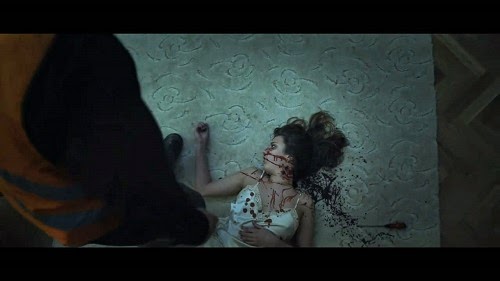
"Woman in Peril," chased by a sadistic madman, is par for the course in Karapetian's The Man in the Orange Jacket (2014)
Like several of the films that I saw at the Fantasia Film Festival, Aik Karapetian's The Man in the Orange Jacket (Man in OJ) is an excellent example of squandered potential.  On the whole, the film is fairly derivative of films where a sadistic killer, out of misplaced desire turned to aggression, hunts down a bunch of unlikeable people in a remote location, and dispatches them through a wide selection of weapons/tools.  If Karapetian is attempting to craft a story where we are not sympathetic towards the victims or the perpetrator, he succeeds.  Yet the film has some significant moments that suggest that he's trying for something more complex and powerful--especially in regards to Eastern European class tensions.

The camera tracks our killer as he jogs on the property
Here is where the film works: the cinematography in the Man in OJ is simply stunning, and the multiple tracking shots in the beginning of the film as it follows the man (Maxim Lazarev) leave his harbor job, travel to his boss's home, kill both the big wig and his younger wife, and then proceed to live "large" in the mansion he has invaded--well, these images are gorgeous.  Karapetian masterfully manipulates the space of the mansion, and his opening and closing of the doors that divide this space increases the film's tensions exponentially.  Shadows and light create a misty, grey netherworld where what is real and fantasy becomes more and more unclear.

The Man in OJ lounges in his new-found solarium
The film also cleverly explores what it might be like to live like "the haves," when all one has known is what it's like to "have not."  The man initially struggles with his new luxuries.  He wears his male victim's clothes (even though they are not REMOTELY the same size), he lounges in his robe, he smokes his cigars (and hacks violently).  The man goes out to dinner, and gorges on rich food that he has no idea how to eat (when all else fails, use your fingers).  He then proceeds to get violently ill, and tries to recuperate in a bubble bath.  He's not even good at hiring prostitutes.  If I'm being generous, I would say that the film tries to critique the fantasy of affluent masculinity, suggesting that money and power are not easily obtained through violent class overthrow.  At the same time, does the film imply that wealth's pleasures are illusory, or that one just really needs to be "born to it?"  

The required half-naked dead girl, snuffed out after a long chase scene
Most of the film's deeper questions fall flat because of the seemingly requisite amount of gendered sexual violence on display.  This particular focus undermines any class critique, as the film frequently devolves into a "boogeyman" with a weapon chase narrative.  The film's kills are straight out of the "Carol Clover guide to slasher films," with the male character dispatched with one blow, and with the women gratuitously clad and on the run from an almost supernaturally empowered killer.  True, the man (in OJ) is shown to be both dis-empowered and riddled by guilt over his deeds, but that part of the film MAKES NO DAMN SENSE unless one chalks up the whole thing to fantasies nestled in his deranged mind.  Major cop-out.  

I initially was hoping that the film was transforming into a circular pattern, where another Man in OJ shows up, and, thinking the first man (in OJ) is the boss (who recently laid off thousands of people who work at the harbor), he goes all homicidal on him.  So the man who initially INVADES the home gets his home invaded, and so on, and so on, infinity.  (I think these time travel, mind fu** films are starting to infect my brain).  See, here is where the film had some real potential! Yeah, but that narrative does not happen.  Instead, the man seems to have a lot of misplaced, unmotivated guilt (which undermines all his previous actions), and then out of nowhere there's a really dumb Final Girl twist.  Really dumb.  Thankfully, the film clocks in at 71 minutes, so it's over pretty quickly.  I wouldn't say that it's not worth seeing for some of its visual inventiveness, but ultimately that The Man in the Orange Jacket disappoints.

The Midnight Swim--Sarah Adina Smith (2014)

June's (Lindsay Burdge) forlorn selfie from Sarah Adina Smith's The Midnight Swim (2014)
I cannot help but cheer when a new female filmmaker breaks out with a powerful, enigmatic film.  Sarah Adina Smith's debut feature The Midnight Swim (2014) has a mystical, ethereal quality which does not make it fit neatly into the "horror cinema" box.  Yet the film's mysteries, and their psychological effects on its characters, help create a very haunted atmosphere, saturated with dread.

The film begins as Amelia Brooks' three daughters, sensible Annie (Jennifer Lafleur), sensual Isa (Aleksa Palladino), and awkwardly neurotic June (Lindsay Burdge) reunite in the wake of their mother's disappearance.  None of the women seem especially surprised by their mother's "death," as her life had become focused on finding the bottom of a seemingly bottomless lake--one on which rests the family's vacation home.  The sisters are there, ostensibly, to get their mother's assets in order, but the focus of the story leans more heavily on the intricately knotted relationships between the siblings.  Watching the tensions and affections between these women blossom and unfold is one of the richest pleasures that the film brings.  Smith really nails the rhythms between female siblings.  Their recent loss brings out both their playfulness with each other, as well as their competitiveness.  Mental Illness lurks in their past as well.

Isa, June and Annie lip sych "Free to Be You and Me"
Joined by a childhood pal/crush, Josh (Ross Partridge), one night in fun, the women decide to invoke the "seven sisters" myth--a dark fairy tale that combines a narrative about entrapped femininity, female powerlessness, and nature's thirst for vengeance.  While initially nothing seems to come of it, as the weekend unfolds, strange events start to occur.  Dead birds show up on their doorstep, noises are heard in the night, and someone or something gets a hold of June's video camera and shoots night footage of a midnight swim.  Has one of the seven sisters come back to haunt them, or is their mother talking to them from the other side?

June's camera symbolizes her distorted worldview
The Midnight Swim could be considered largely a "found-footage film" in that from the film's earliest moments, the experiences at the lake are seen exclusively through June's camera lens.  Since June is a documentary filmmaker, this perspective does not seem initially that out of the ordinary.  Annie and Isa seem fairly used to the camera always being present (and recording).  Other characters, not so much.  In one particularly striking scene, a real estate agent over to discuss selling the house is the target of June's scrutiny, and her camera slowly and unnervingly zooms into close-up on this poor woman while she tries to talk to the other sisters.  The scene is funny, yet highlights June's use of the camera as a crutch by which she interacts with the world.  The film's focused visual perspective forces the spectator to spend the most time with June, seeing the world through her eyes.  Yet that perspective becomes problematic when it becomes more and more clear that June is an unreliable and perhaps rather unstable narrator.  The film's visual authority then becomes suspect.

The film's fairy tale elements are undermined by June's mental instability
June's tenuous grasp of reality somewhat tempers the film's aura of supernatural dread.  Even a film directed by a woman seems unable to escape the cultural struggles women filmmakers undergo to maintain narrative and visual authority.  Like another famous documentary filmmaker lost in the supernatural woods--Heather Donohue from The Blair Witch Project--June's single-minded interest in documenting the spooky events at the lake house are ultimately framed as misguided symptoms of a woman who cannot be trusted or believed.

Who actually is taking the Midnight Swim?
While I am mildly disappointed by the way mental illness is wielded in the film's narrative, and to whom it concerns, in no way does it truly take a way from this film's visual, aural, and narrative triumphs.  I don't know if two glowing reviews, from Twitch and Indiewire respectively, frame this film as an "critical darling," but I'll throw my hand in by saying that The Midnight Swim is one of the most striking and provocative achievements that I've seen at the Fantasia Film Festival so far.  I hope Ms. Smith gets a distributor for this film, so that more people can experience her sharply drawn and evocative world.

Saturday, July 26, 2014

Honeymoon--Leigh Janiak (2014)

Things go wrong too quickly for Paul (Harry Treadaway) and Bea (Rose Leslie) in Honeymoon (2014)
Ah, Honeymoon. This film has so much potential, truly, but this tale of a Honeymooning couple who run afoul of something in the woods outside Bea's childhood family retreat just cannot rise above the questions it leaves hanging, or the gore and shock tactics that render women's bodies horrifying and disgusting.  I'm disappointed to see that this viewpoint, entirely told through the eyes of the male protagonist, Paul, is written and directed by a woman.  Heavy sigh.  This film is her first, and though it has some issues, I hope it is not her last.

The film suggests that one can never know one's spouse, especially if after finding her walking around in the woods in the middle of the night, he awakens to find her unable to brew coffee or make french toast adequately.  The HORROR!  Paul is suspicious and proceeds to test Bea at every turn, especially after going back to where he found her in the woods and finding her torn nightgown.  The biggest problem with this film is that there is no building of tension or slow burn.  Change happens very quickly, and the film has virtually no suspense.

Paul investigates Bea's sexy nightgown
While Treadaway is really quite delightful as Victor Frankenstein on Showtime's Penny Dreadful, and Rose Leslie is also great on Game of Thrones, there really is no chemistry between these actors in this film.  They seem to be sniping at each other very soon into the honeymoon, and the film goes to some length to maintain Bea's "mystery" by never getting into her head.  She's constantly scrutinized by her new husband, and the audience is supposed to be discovering the horror right along with Paul.  Yet, I found him so unappealing and unlikeable (his decision to go and catch fish in the early morning hours utterly idiotic), that I just wanted him to die...like right away.  Instead, the camera follows him around as he (and we) piece things together.

"You Know Nothing, Paul!"
The world gets weirder as the story evolves.  The one clear thing is that "something bad" happened to Bea in the woods, and its affecting her body, especially her lady parts.  She has some nasty, scabby "mosquito" bites on her inner thighs, she starts spontaneously bleeding, self-mutilates herself at one point, and then there's a truly gross-out scare that sends everything into hyper-drive.  After that moment, Bea becomes completely and utterly abject, and one wonders just how things are going to all shake out.  Unsurprisingly, at this point in the film, Paul loses all interest in her--she's beyond saving.  Thankfully, she is kind enough to help him "hide," even after he's treated her so shoddily.

I can hint at references the film makes--to body snatching, the Evil Dead, possession narratives, alien abduction, The Wicker Man--but what you end up with is mere speculation.  The film never really reveals what happens in the woods, and the spectator is left hanging, attempting to fill in the many plot holes that the film leaves gaping open.  Honeymoon never reaches for cleverness or provides any explanations, which leaves one saying "Okay, then."  The film has so much potential, but it just squanders it.  I think even merely changing things by providing Bea's point-of-view would have made the film far more compelling.  Instead, we're stuck with Paul.


If you want to see a film that explores the abject, female body, but has a more fleshed out female protagonist, I would recommend the fore-mentioned Animosity (2013), or the smart and twisty Dutch horror thriller Left Bank (2008).

Harvest--John McNaughton (2013)

Katherine (Samantha Morton) losing it in The Harvest (2013)
John McNaughton has made some pretty intense films.  The last film of his I saw, Wild Things (1998) was really nuts.  So I shouldn't have expected any less from his latest, The Harvest (2013).  The beauty of the Fantasia Film Festival is that directors show up for Q & As after the screening and tend to really enhance the film's experience.  Without John McNaughton's wry humor and pointed contextualizing, I would not be as respectful of the film as I am.  Still, this film has serious, serious problems.

McNaughton's film is a twisted fairy tale about over-protective and abusive parents, terrible marriages, sick kids, and intrepid young teens fighting against adults who just don't understand.  Oh, and Peter Fonda plays "The Grandfather."

Katherine and Richard (Michael Shannon) are a hot mess
The film opens with a kid being knocked senseless by a baseball hit, and then Katherine, a pediatric surgeon, swooping in and saving his life.  She seems to perform these feats regularly, with Richard as a stay-at-home Dad who takes care of their sickly kid, Andy.  (Richard was formerly a NURSE, which may be how this dyfunctional couple met, but is now just a reminder of how essentially emasculated he is here).

Their son has been sick since birth, and they have him on a somewhat hinky experimental drug regimen that makes him tired, bed-ridden, and barely functioning. 

Andy (Charlie Tahan) must do his homework so he can be a doctor, not a nurse
Both Mom and Dad are really strict though, and make sure that Andy does his home-schooled homework.  Everything goes pear-shaped when a spunky girl, Maryann (Natasha Calis), moves in a mile away and starts skulking around their house, peeking in the windows.  She has recently lost her parents in an accident, and is living with her grandparents, one of which is played by Peter Fonda (who says "Far out" several times, in case we do not know who he is).  Maryann is looking for a friend, and for the sake of the plot, she latches onto Andy after seeing him through his bedroom window.  

pint-sized creeper Maryann
I don't know, you just kind of have to go with it.  Things become very Hansel and Gretel soon afterward, as Katherine does not want Andy to have any friends, and does her best to be creepy and menacing a la evil witch.  Someone yelled "Bitch" out loud in the theater, unsurprising for Samantha Morton succeeds in this fairly thankless, cliched role.  Things get crazier and there's a pretty decent twist towards the end, but the hoary gender tropes are mostly irritating.

During the Q & A, one fellow said, "I've seen so many scary things at this festival--vampires, werewolves, etc.--but nothing scares me more than the psychotic middle-aged Mom."  Yeah, dude, that's kind of the problem.  I would have loved to see a little more nuance to these characters, and for something to be at stake more than "CHILDREN ARE IN PERIL!"  With two fine actors like Morton and Shannon on-board, one would hope for more, but she's a screeching Gorgon and he's some kind of sad kicked dog who flinches all the time.  Then I remind myself that this guy directed Wild Things, which also seemed so utterly nutso, that I just should expect no less from a John McNaughton film. 

Many times during the screening, people laughed at seemingly "unfunny" moments.  Sure, moments of levity are often necessary in a very dark story, but giving the kid mini-marshmellows in his cocoa, or Richard getting dressed after having sex with an adoring drug rep--hilarious!  I did find myself laughing and shaking my head at Katherine much of the time.  Her temper tantrums were so epic, they just elicited chuckles and guffaws.  Samantha Morton must have needed a serious vacation after this film.  McNaughton pointed out that most female actors did not want to touch this role, especially those with kids.  Gee, no kidding.  BTW, Morton has a couple of kids.  I'm thinking that she should show them this film as a kind of cautionary tale--don't piss Mommy off.

The director, during the Q & A, referenced fairy tales and Who's Afraid of Virginia Woolf, and those kernels are there, but they are relatively buried under a histrionic Jody Picoult novel.  Eh.  I'd give it a pass.


Friday, July 18, 2014

Animosity--Brendan Steere (2013)

Tracy Willet as Carrie in Animosity
The Fantasia Film Festival certainly started out with a "bang" with Brendan Steere's Animosity (2013), a twisty indie horror film that kept me guessing right until the end...and left me with a few questions.  I like films that still have me thinking after they are over.  In the Q&A afterwards, I didn't want to know the answers to all of my questions, so some mysteries are still left intact.  I'll try to be careful of what I give away, but inevitably there will be some spoilers...

This film definitely reminds one of the "perils of home ownership," as viewers are introduced to the leads, Carrie and Mike, as they are buying a new house.  They arrive shortly after the house's former owner has seemingly killed her daughter (and that opening scene is truly a stunner).  Immediately, one thinks "what's wrong with this house?"  Yet, the film flashes forward to Carrie and Mike days into their moving in, with boxes still packed and the house without phone or internet service (so they've bought the place, but they are isolated).  So far so good.


Thankfully, the film takes place almost entirely through Carrie's subjective perspective.  She's a composer who is currently scoring a "B" horror film, while Mike works at some lab with Carl and Nicole, who carpool with him to work.  The film's slow burn comes from Carrie's days at home, where she hears strange sounds and encounters her creepy neighbor, Tom, who likes to shoot at things with a sawed-off shotgun.  Steere states that the first half of the film is reminiscent of Rosemary's Baby, and the way that the film hews close to Carrie while making everyone else seem rather enigmatic--especially Mike--contributes to that feeling of creeping dead.  Inevitably, weird sh** starts happening and no one believes Carrie.  Or they are working hard to convince her that she's imagining things.  The male characters are pretty damn despicable throughout, and that might be the film's one flaw--it's hard to sympathize with Mike (Marcin Paluch), and one gets the sense that we should toward film's end.  His loathsomeness is balanced beautifully by Tracy Willet's truly remarkable performance as Carrie.  She is simultaneously sympathetic and fierce, and wholly riveting.

At the 40 minute mark, the film takes a rather dramatic turn, and offers up revelations that serve to further complicate the mysteries involved.


This film really does have everything.  Beyond Rosemary's Baby, the recipe calls for some Haute Tension, a touch of Texas Chainsaw, some Evil Dead, and a healthy dose of Pet Cemetery--with even some mad science thrown in for good measure.  In the Q & A, Steere said that he really wanted to make Solaris, but he couldn't do outer space, so he shot it at his parents' place in Pennsylvania. These woods are seriously, seriously eerie, and the film's sound team does an excellent job of ratcheting up the tension.  Most of all, despite any small plot fissures, this film is wickedly smart, not relying on the jump scares and "final girl" cliches that are so common to contemporary horror cinema.  The film's world building may reference other films, but in many ways, its wholly original and a strong showing for a first feature.

Steere jokingly suggested that the film leaves an opening for Animosity 2, and the film has the kind of "trick film" structure that merits repeat viewings and a continuation of the film's mythos.  Still, don't call it Animosity...the title is the least interesting thing about this film.  Perhaps naming it something else would have given too much away, and hopefully I haven't done so in reviewing it.  I now appreciate the film's poster even more.  Where can I get one??