Showing posts with label Horror Films. Show all posts

Tuesday, July 14, 2015

Fantasia Film Festival 2015


Well, my blog is back on!  I'd like to say permanently, but it's hard to make such promises.  I'm lucky enough to be back in Montreal at the 2015 Fantasia Film Festival.  This year I'm living in a really cozy Montreal neighborhood some distance from the festival.  I love where I live, but it may become a handicap to easily see films considering the vagaries of public transportation and the long lines waiting for screenings.  Yet, I'm next to two cheese shops, above a wine store, less than a block from a nice grocery, across the street from an ice cream shop, near really amazing restaurants, bars, boutiques--a very desirable location.  My location makes me want to live here permanently!  I cannot say enough great things about Montreal.  Including this festival.

This year I've cut down my screenings a bit.  Last year I saw something like 23 movies.  This year I have tickets for 16 films.  Last year, with living so close and staying for the entire festival, I felt I should indulge, and I did experience festival fatigue.  This year, I think I'm being more discriminating, but I'm probably delusional, and still signed onto too many films.  This festival will be intense yet again.  Here's what's on the agenda (I'm just providing links for trailers, since they can be wonky sometimes if I embed them, so just click the title to see the trailer, if one is posted.):

Tangerine--Sean Baker (2015)
I realize that I could probably see this film in theaters in the U.S., but why should one wait?  The rave reviews that Tangerine has garnered since it screened at Sundance this winter have convinced me that this beautiful, funny indie will be well worth seeing immediately.  I love the banter between the female leads, and the film looks gorgeous, gritty, and fun.

The Hallow--Corin Hardy (2015)
The woods are a seriously scary place, full of shadows, crackling twigs, glowing eyes, slithering sounds...things are watching you there, ready to pounce.  I grew up in rural areas where the woods were a haven and refuge, but also a place replete with dark mysteries and shadows.  I have not been to Ireland yet, but word is that it's full of wee faerie folk, or scary demon creatures as Corin Hardy's The Hallow suggests.  I'm mildly irritated by the tossing in of a wee-baby-in-peril plot, but maybe it's changeling fodder.

Catch Me Daddy--Daniel Wolfe (2014)
Catch Me Daddy was shot by one of my favorite cinematographers, Robbie Ryan, who was DP for the glorious Fish Tank (Andrea Arnold 2009).  Yes, the film has been heralded as "gripping," but often I'm swayed by films that are beautiful.  This one fits that category.  Just look at the poster!


and no, it's not a "monster movie" in the typical sense...

Therapy for A Vampire--David Ruhm (2014)
I know, I know, it's a horror comedy, and I pretty uniformly hate them.  They never strike the right balance of funny or scary, and I'll never be a fan of the gross-out adolescent humor that's a trademark of so many of these films.  Still, Gerard Johnstone's Housebound from last year was pretty awesome, even on repeat viewing. And this vampire is getting analyzed by Freud, so what's not to like.  I aspire to be as cool and elegant as his vamp wife in Therapy for a Vampire.  The film was sold out for opening night, so I'm going to the less boisterous afternoon show where things will probably be substantially chill.

Bridgend--Jeppe Ronde (2015)
I like the soft, placid quality of this image which belies the roiling tension and dread at the heart of Bridgend.  I'm glad that Hannah Murray, who plays Gilly on GOT, beautifully embodies the lead in this film, since I'm one of those viewers who broke up with Thrones at the end of this last season.  The actress combines a fierceness with a touching vulnerability that makes her compelling to watch.

Extinction--Miguel Angel Vivas (2015)


When I was first perusing the weighty Fantasia program for this year, Extinction was firmly in the maybe pile, mostly because if Matthew Fox (from Lost) is in the film, I'll probably just be annoyed.  Although Jeffrey Donovan (from Burn Notice) could even out that weighty imbalance.  Then I saw the trailer, and I was convinced that adaptive snow zombies could really make the film worthwhile.  The images from the film are pretty stunning, and I've learned that Spanish horror directors really have a handle on creating beautiful terrors.
We Are Still Here--Ted Geoghegan (2015)
When will people learn that going to live in some isolated house in the middle of nowhere is never really a great idea??  Barbara Crampton and her husband decide to rent a former turn-of-the-century funeral parlor in winter, and bad things happen.  We Are Still Here has gotten such raves, and looks so damn scary, AND it's hosted by the director, cinematographer Karim Hussein and Barbara Crampton at Fantasia.  These types of interactions with visionaries and stars makes Fantasia that much more thrilling.

Goodnight Mommy--Severin Fiala and Veronika Franz (2014)
I'm currently working on an article on Maternal Ambivalence vs. Evil Kids, looking at We Need to Talk about Kevin and The Badabook, so Goodnight Mommy has been on my radar very early on.  It's one of the few horror features co-directed by a woman too.  Mom's looking pretty scary here, but those kids should put down those scissors!  Another film sold out for the night screening, but I'm lucky enough to see it the afternoon before.  

The Reflecting Skin--Philip Ridley (1990)
I loved the spooky, surreal The Reflecting Skin when I happened to catch it the first time on some cheap video tape.  I bootlegged a rickety copy for myself back then, and then waited, and waited, and waited for the film to be released on DVD.  Now it's been properly 2K remastered for its 25th anniversary, and I'm so excited to see this gorgeous, provocative film on the big screen for the first time.

Observance--Joseph Sims-Dennett (2015)
I was also sitting on the fence regarding Joseph Sims-Dennett's Observance--yet another film about a vulnerable guy who has lost a kid and had his marriage crumble in the aftermath, who then tries to make some easy money by channeling his voyeurism.  I can get behind a guy who gets in trouble for watching.  I just hope that this Australian film introduces some unique takes on the ubiquitous male voyeurism plot.  Sadly, I'll miss the director Q & A because I'm going to the second screening.

Anguish--Sonny Millhi (2015)
This film is the one about which I'm most excited, and it's making its World Premiere at Fantasia this year (although I'm not able to see the director's Q & A).  Every time I watch the trailer for Anguish, I want to watch it again immediately afterwards.  This film looks so utterly chilling, and Ryan Simpkins is a truly powerful young actress.  If you haven't seen Jennifer Lynch's Surveillance or Tom Ford's A Single Man, where she plays small but significant roles, then you should as soon as possible. 
Tales of Halloween--anthology horror film
Out of several anthology horror films playing at Fantasia this year, Tales of Halloween is the only one with a female director, Axelle Carolyn (who will be present at Fantasia's World Premiere screening).  Of course, horror films are just a part of a male-dominated film industry, but I just get tired of watching a film with 10 different directors, and only one of them is a woman.  Don't get me started on the ABC's of Death films.  The industry throws a token bone like XX--a horror anthology solely consisting of female horror directors--but that's not going to satisfy my thirst for female-directed horror.

Cherry Tree--David Keating (2015)
I know virtually nothing about this film other than it's directed by David Keating, who did the fabulous Wake Wood (2010), and it's about witches.  No trailer, no reviews, nada.  Not to be confused with Curse of the Witching Tree.

The Dark Below--Douglas Schultze (2015)
Every time I try to describe Douglas Schultze's The Dark Below to someone, they promptly freak out on me--why would you want to see a film like that??  Well, I was one of those kids that built a fort in the crawlspace in her closet.  I also could totally dig one of those immersive sensory deprivation tanks.  I like some small spaces.  Here's the blurb from Fantasia: 

"As the story opens, Rachel (Lauren Shafer) is drugged and abducted by a ruthless man (David GB Brown) who takes her to a frozen-over lake in the dead of night. A hole has been hacked in the ice, and it’s clear that that’s where Rachel is intended to go. But he has already outfitted her with a full wetsuit, and rigs her with scuba gear before submerging her. Clearly he doesn’t intend for her to die right away, and as she struggles to survive in the frigid depths, we learn more about both of their pasts, and what has led them to this harrowing point."

Yeah, it sounds utterly terrifying, and has only one line of dialogue, which means the film is going to be a lesson in visual storytelling.  Sometimes films can fall a little flat when they rely on visuals alone (see my review of The Man with the Orange Jacket from last year).  This film looks scary and cool.

Shrew's Nest--Juanfer Andres and Estaban Roel (2014)

Shrew's Nest has been around the block quite a bit since premiering in 2014, and has gotten some very positive reviews when it screened at Fantastic Fest, TIFF, Morbido, and Brussels.  In some ways, I'm over the repressed religious psycho female horror film, but this film takes place all in one cramped Spanish apartment, and as I mentioned, I like small spaces.  Why not.

The Visit--Michael Madsen (2015)
Last year one of the genuine surprises of the Fantasia film festival was this cool documentary on Slime molds, Tim Grabham and Jasper Sharp's The Creeping Garden.  So this year, I had to sneak in one doc, and this one, where the spectator takes the place of an alien invader being greeted by believers in The Visit seems right on target.  Weird mixed with gorgeous visuals works for me.

Friday, August 22, 2014

The House at the End of Time--Alejandro Hidalgo (2013)

Dulce (Ruddy Rodriguez) struggles to survive her home in The House at the End of Time (2013)
Alejandro Hidalgo's The House at the End of Time, touted as on of the first Venezuelan horror films, masquerades as a Haunted House film.  The film opens with the above image as Dulce (Ruddy Rodriguez) tries to save her son, Leo, and her husband, Juan Jose, from what appears to be a mysterious force possessing her home.  The most vivid image in this opening is of Leo seemingly sucked into a doorway in the house's dank basement.  Fast forward to 30 years later, and Dulce, now an old woman, has returned to her home, albeit now under house arrest after serving time in prison for murdering her family.  She is undeniably a woman haunted--by her past, and the events that continue to confuse her.  This film's narrative mysteries and oppressive atmosphere nod to a couple of my favorite Spanish language horror films: Alejandro Amenabar's The Others (2001) and J.A. Bayona's The Orphanage (2007).  Still, there is more to this film than one might expect.

This cliched image of a woman, in her nightgown, on a staircase, with a knife, belies the film's true power
Unfolding primarily through flashbacks, The House at the End of Time uses many of the haunted house tropes with which we are familiar.  Strange noises repeatedly occur, from footsteps, to the frantic turning of doorknobs, to fevered pounding on the doors.  The layout of the house is utterly disorienting, with hallways leading to nowhere, bedrooms far away from each other, and a basement that stretches in all sorts of mysterious directions.  The secrets of the house are symbolized by the numerous locked doors always in danger of being breached (which also produces numerous scenes of Dulce fumbling with keys).

We share Leopoldo's terror
Much of the film focuses on Dulce's family--her two sons, Leopoldo (Rosmel Bustamante) and Rodrigo (Hector Mercado), and Juan Jose (Gonzalo Cubero), the kids' father and Dulce's no-good, alcoholic husband.  The chief conflicts occur as Leo and Rodrigo fight for the affections of a neighborhood girl, and Juan Jose learns that he is actually not Leo's biological father (something the audience learns relatively early in the flashbacks).  These revelations spur jealousy and even violent rage amongst the male characters, and unsurprisingly, Dulce's sacrificing, protective mother is the one who suffers for it.  The tensions in the film are pushed by showing children in frequent peril.

Dulce is determined to uncover what really happened to her family 30 year ago
Something is wrong with the house, and The House at the End of Time dabbles in the spiritual in order to explain things--but even those scenes are a bit of a ruse that adds to the film's layered confusion.  In one of the film's most creepy-fun scenes, a younger Dulce visits with a fortune teller/psychic in order to get in touch with the spirit world and figure out what's going on.  The spiritualist, Victoria, seems straight out of Fellini's Juliet of the Spirits (1965).  

Later, Dulce is visited by a Priest (Guillermo Garcia) who both believes in her innocence and was a childhood friend of her sons.  Since she cannot move freely, tied to her home, he agrees to do the detective work for her, looking through numerous documents in order to determine the house's sordid history--one filled with violence, mysterious events, vanishing family members, and all manner of "hauntings."  In delving into the house's past, the priest concludes that something seems to happen to it every 30 years.  And its almost another 30 years passed....

The horrors are back for Dulce some 30 years later
While much of what I've described so far might seem derivative of quite a few other haunted house films, one thing truly sets this film apart from the rest:  Time Travel.  I know.  This theme has been a near constant at this Fantasia Fantasia Film Festival, and I'm really trying to puzzle out why it's so in vogue at the moment.  Is it because technology has created some kind of gap between our experience of history and its representation so that the world seems infinitely manipulable?  Are these films trying to grapple with the notion that one never seems to learn from the past, so that fate and time paradoxes are intertwined and inevitable?  One thing that is consistent over all the films that I've seen exploring these ideas--someone always, always gets hurt. Casualties of time manipulated.  Yet in this film, there's also a degree of hope that lingers.

I'm not going to explain how time travel works in The House at the End of Time.  The title of the film is its own spoiler, but that little shift in narrative knowledge really changes the tempo and the perspective of the film.  This revelation gives the film quite a few "wow" moments, and takes what might seem like a somewhat typical horror film into a whole new dimension (pun intended).  The film is also surprisingly affecting in an emotionally poignant and moving manner.  While the film has relatively few characters, their nuanced performances, especially in scenes that highlight either pathos or humor, elevate the film in unique ways.  Some of the film's more religious overtones I found a bit heavy-handed, but as a whole, I was impressed by its unique mix of elements and themes.  Definitely worth seeing.

Thursday, August 7, 2014

At the Devil's Door--Nicholas McCarthy (2014)

Ashley Rickards as the babysitter from hell in At the Devil's Door

Nicholas McCarthy really knows how to make a house vibrate with terror and dread.  I deeply and sincerely love his film The Pact (2012), which is one of those films that I happened to find on Netflix (watch the trailer).  His first feature was about a seriously scary closet.  Okay, the film explored more than just "scary closets," but this calling card gave a strong sense of how McCarthy negotiated fear, women, madness, and cinematic space.  Even Casper Von Diem was good in it, and that's saying something.  So I highly anticipated his latest film.  I have some positive things to say about At the Devil's Door, but as a whole, it was a disappointing follow-up to his first film.  This second effort indicates how a bigger budget might actually hamper a filmmaker's creative integrity.  It feels like McCarthy is trying to please someone else or pander to a wider audience.  While I understand that motivation, I'm unhappy about the outcome.

The film opens with a young female narrator reading from some tome that warns the world about the devil, his mark, and the number 666--just in case we weren't clear that some devil/demon is involved based on the film's title.  Then the film follows a teenager (Ashley Rickards) fooling around with her new boyfriend.  He tells her about a quick way to make $500 by playing some game dictated by a creepy occult guy with mysterious motives.  He tells her to go to the crossroads and say her name, and he will know her, and that she's the perfect vessel, blah, blah blah.  She proceeds to blow her new windfall on some cool red kicks and some goth make-up and nail polish, but then she hears some weird noises coming from the armoire (which is basically a free-standing closet).  Before we know it, she's up in the air, being thrown around and invaded by some mysterious malevolent force...and then she no longer feels like herself.  We get to witness her being the WORST BABYSITTER ever, a truly great antidote to the over-earnest parents who think that their baby is the greatest kid on earth.  McCarthy also dresses the girl in a shiny, red hooded rain slicker, which really ups the fairy-tale, Red Riding Hood gone bad quotient.

What's hiding in the armoire?
Fast forward to Leigh (Catalina Sandino Moreno from Maria Full of Grace) as the sweet real estate agent who is eager to sell the girl's former home, fully unaware of the events that previously occurred there.  She finds a whole host of weird stuff, including a big burn mark in the girl's bedroom, a noisy armoire with a $500 roll of bills in its bottom drawer, and a mirror draped in black--which doesn't make her hesitate about selling the house AT ALL!  Luckily red-riding slicker shows up and lurks around the house quite a bit, distracting the good-hearted Leigh from selling the place quickly.  As you might imagine, things continue to go downhill from there.

The film becomes derivative in how it shapes its "possession narrative" and how it nestles horror within the fertile female body.  McCarthy does the "sinister home" beautifully, but he's less assured when it comes to the devil.  As the film progresses, he loses sight of his unique female characters, and quite literally treats them like "vessels" for something evil, moving from our red-riding slicker girl, to Leigh, to her artist-sister Vera (played by Naya Rivera).  The last twenty minutes of the film drag as the plot tries to tie up its loose ends; the biggest problem is that by the time we are left with Vera, the least compelling of the female characters, it's hard to really care what happens.

Sometimes Vera should look behind her
Still, At the Devil's Door has a few moments that, once witnessed, are literally burned into the spectator's brain.  McCarthy is more interested in leveraging atmosphere by stretching what occurs on the edges of the frame rather than adding a lot of telegraphed jump scares.  One particular image in front of a mirror is one of the greatest images from any of the films at Fantasia.  Also there's some awesome evil kid action.  Yet like Honeymoon, the film left me wanting more information in some places, and wishing the film "didn't go there" at other times.  What was missing most from McCarthy's second feature was the building of suspense.  At times, the film has an original vision, but in the end, it falls into too many well-worn tropes.  Too damn predictable.  While I'll still call myself a fan of his work, I'm hoping that his next film will be a bit more imaginative and unique.

Sunday, August 3, 2014

The Man in the Orange Jacket--Aik Karapetian (2014)

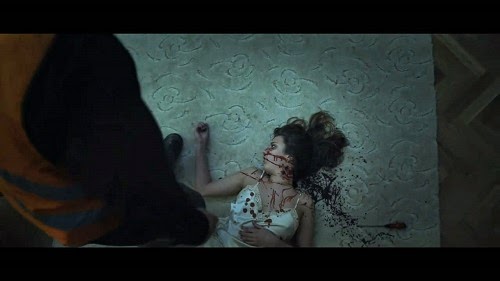
"Woman in Peril," chased by a sadistic madman, is par for the course in Karapetian's The Man in the Orange Jacket (2014)
Like several of the films that I saw at the Fantasia Film Festival, Aik Karapetian's The Man in the Orange Jacket (Man in OJ) is an excellent example of squandered potential.  On the whole, the film is fairly derivative of films where a sadistic killer, out of misplaced desire turned to aggression, hunts down a bunch of unlikeable people in a remote location, and dispatches them through a wide selection of weapons/tools.  If Karapetian is attempting to craft a story where we are not sympathetic towards the victims or the perpetrator, he succeeds.  Yet the film has some significant moments that suggest that he's trying for something more complex and powerful--especially in regards to Eastern European class tensions.

The camera tracks our killer as he jogs on the property
Here is where the film works: the cinematography in the Man in OJ is simply stunning, and the multiple tracking shots in the beginning of the film as it follows the man (Maxim Lazarev) leave his harbor job, travel to his boss's home, kill both the big wig and his younger wife, and then proceed to live "large" in the mansion he has invaded--well, these images are gorgeous.  Karapetian masterfully manipulates the space of the mansion, and his opening and closing of the doors that divide this space increases the film's tensions exponentially.  Shadows and light create a misty, grey netherworld where what is real and fantasy becomes more and more unclear.

The Man in OJ lounges in his new-found solarium
The film also cleverly explores what it might be like to live like "the haves," when all one has known is what it's like to "have not."  The man initially struggles with his new luxuries.  He wears his male victim's clothes (even though they are not REMOTELY the same size), he lounges in his robe, he smokes his cigars (and hacks violently).  The man goes out to dinner, and gorges on rich food that he has no idea how to eat (when all else fails, use your fingers).  He then proceeds to get violently ill, and tries to recuperate in a bubble bath.  He's not even good at hiring prostitutes.  If I'm being generous, I would say that the film tries to critique the fantasy of affluent masculinity, suggesting that money and power are not easily obtained through violent class overthrow.  At the same time, does the film imply that wealth's pleasures are illusory, or that one just really needs to be "born to it?"  

The required half-naked dead girl, snuffed out after a long chase scene
Most of the film's deeper questions fall flat because of the seemingly requisite amount of gendered sexual violence on display.  This particular focus undermines any class critique, as the film frequently devolves into a "boogeyman" with a weapon chase narrative.  The film's kills are straight out of the "Carol Clover guide to slasher films," with the male character dispatched with one blow, and with the women gratuitously clad and on the run from an almost supernaturally empowered killer.  True, the man (in OJ) is shown to be both dis-empowered and riddled by guilt over his deeds, but that part of the film MAKES NO DAMN SENSE unless one chalks up the whole thing to fantasies nestled in his deranged mind.  Major cop-out.  

I initially was hoping that the film was transforming into a circular pattern, where another Man in OJ shows up, and, thinking the first man (in OJ) is the boss (who recently laid off thousands of people who work at the harbor), he goes all homicidal on him.  So the man who initially INVADES the home gets his home invaded, and so on, and so on, infinity.  (I think these time travel, mind fu** films are starting to infect my brain).  See, here is where the film had some real potential! Yeah, but that narrative does not happen.  Instead, the man seems to have a lot of misplaced, unmotivated guilt (which undermines all his previous actions), and then out of nowhere there's a really dumb Final Girl twist.  Really dumb.  Thankfully, the film clocks in at 71 minutes, so it's over pretty quickly.  I wouldn't say that it's not worth seeing for some of its visual inventiveness, but ultimately that The Man in the Orange Jacket disappoints.

The Midnight Swim--Sarah Adina Smith (2014)

June's (Lindsay Burdge) forlorn selfie from Sarah Adina Smith's The Midnight Swim (2014)
I cannot help but cheer when a new female filmmaker breaks out with a powerful, enigmatic film.  Sarah Adina Smith's debut feature The Midnight Swim (2014) has a mystical, ethereal quality which does not make it fit neatly into the "horror cinema" box.  Yet the film's mysteries, and their psychological effects on its characters, help create a very haunted atmosphere, saturated with dread.

The film begins as Amelia Brooks' three daughters, sensible Annie (Jennifer Lafleur), sensual Isa (Aleksa Palladino), and awkwardly neurotic June (Lindsay Burdge) reunite in the wake of their mother's disappearance.  None of the women seem especially surprised by their mother's "death," as her life had become focused on finding the bottom of a seemingly bottomless lake--one on which rests the family's vacation home.  The sisters are there, ostensibly, to get their mother's assets in order, but the focus of the story leans more heavily on the intricately knotted relationships between the siblings.  Watching the tensions and affections between these women blossom and unfold is one of the richest pleasures that the film brings.  Smith really nails the rhythms between female siblings.  Their recent loss brings out both their playfulness with each other, as well as their competitiveness.  Mental Illness lurks in their past as well.

Isa, June and Annie lip sych "Free to Be You and Me"
Joined by a childhood pal/crush, Josh (Ross Partridge), one night in fun, the women decide to invoke the "seven sisters" myth--a dark fairy tale that combines a narrative about entrapped femininity, female powerlessness, and nature's thirst for vengeance.  While initially nothing seems to come of it, as the weekend unfolds, strange events start to occur.  Dead birds show up on their doorstep, noises are heard in the night, and someone or something gets a hold of June's video camera and shoots night footage of a midnight swim.  Has one of the seven sisters come back to haunt them, or is their mother talking to them from the other side?

June's camera symbolizes her distorted worldview
The Midnight Swim could be considered largely a "found-footage film" in that from the film's earliest moments, the experiences at the lake are seen exclusively through June's camera lens.  Since June is a documentary filmmaker, this perspective does not seem initially that out of the ordinary.  Annie and Isa seem fairly used to the camera always being present (and recording).  Other characters, not so much.  In one particularly striking scene, a real estate agent over to discuss selling the house is the target of June's scrutiny, and her camera slowly and unnervingly zooms into close-up on this poor woman while she tries to talk to the other sisters.  The scene is funny, yet highlights June's use of the camera as a crutch by which she interacts with the world.  The film's focused visual perspective forces the spectator to spend the most time with June, seeing the world through her eyes.  Yet that perspective becomes problematic when it becomes more and more clear that June is an unreliable and perhaps rather unstable narrator.  The film's visual authority then becomes suspect.

The film's fairy tale elements are undermined by June's mental instability
June's tenuous grasp of reality somewhat tempers the film's aura of supernatural dread.  Even a film directed by a woman seems unable to escape the cultural struggles women filmmakers undergo to maintain narrative and visual authority.  Like another famous documentary filmmaker lost in the supernatural woods--Heather Donohue from The Blair Witch Project--June's single-minded interest in documenting the spooky events at the lake house are ultimately framed as misguided symptoms of a woman who cannot be trusted or believed.

Who actually is taking the Midnight Swim?
While I am mildly disappointed by the way mental illness is wielded in the film's narrative, and to whom it concerns, in no way does it truly take a way from this film's visual, aural, and narrative triumphs.  I don't know if two glowing reviews, from Twitch and Indiewire respectively, frame this film as an "critical darling," but I'll throw my hand in by saying that The Midnight Swim is one of the most striking and provocative achievements that I've seen at the Fantasia Film Festival so far.  I hope Ms. Smith gets a distributor for this film, so that more people can experience her sharply drawn and evocative world.

Saturday, July 26, 2014

Honeymoon--Leigh Janiak (2014)

Things go wrong too quickly for Paul (Harry Treadaway) and Bea (Rose Leslie) in Honeymoon (2014)
Ah, Honeymoon. This film has so much potential, truly, but this tale of a Honeymooning couple who run afoul of something in the woods outside Bea's childhood family retreat just cannot rise above the questions it leaves hanging, or the gore and shock tactics that render women's bodies horrifying and disgusting.  I'm disappointed to see that this viewpoint, entirely told through the eyes of the male protagonist, Paul, is written and directed by a woman.  Heavy sigh.  This film is her first, and though it has some issues, I hope it is not her last.

The film suggests that one can never know one's spouse, especially if after finding her walking around in the woods in the middle of the night, he awakens to find her unable to brew coffee or make french toast adequately.  The HORROR!  Paul is suspicious and proceeds to test Bea at every turn, especially after going back to where he found her in the woods and finding her torn nightgown.  The biggest problem with this film is that there is no building of tension or slow burn.  Change happens very quickly, and the film has virtually no suspense.

Paul investigates Bea's sexy nightgown
While Treadaway is really quite delightful as Victor Frankenstein on Showtime's Penny Dreadful, and Rose Leslie is also great on Game of Thrones, there really is no chemistry between these actors in this film.  They seem to be sniping at each other very soon into the honeymoon, and the film goes to some length to maintain Bea's "mystery" by never getting into her head.  She's constantly scrutinized by her new husband, and the audience is supposed to be discovering the horror right along with Paul.  Yet, I found him so unappealing and unlikeable (his decision to go and catch fish in the early morning hours utterly idiotic), that I just wanted him to die...like right away.  Instead, the camera follows him around as he (and we) piece things together.

"You Know Nothing, Paul!"
The world gets weirder as the story evolves.  The one clear thing is that "something bad" happened to Bea in the woods, and its affecting her body, especially her lady parts.  She has some nasty, scabby "mosquito" bites on her inner thighs, she starts spontaneously bleeding, self-mutilates herself at one point, and then there's a truly gross-out scare that sends everything into hyper-drive.  After that moment, Bea becomes completely and utterly abject, and one wonders just how things are going to all shake out.  Unsurprisingly, at this point in the film, Paul loses all interest in her--she's beyond saving.  Thankfully, she is kind enough to help him "hide," even after he's treated her so shoddily.

I can hint at references the film makes--to body snatching, the Evil Dead, possession narratives, alien abduction, The Wicker Man--but what you end up with is mere speculation.  The film never really reveals what happens in the woods, and the spectator is left hanging, attempting to fill in the many plot holes that the film leaves gaping open.  Honeymoon never reaches for cleverness or provides any explanations, which leaves one saying "Okay, then."  The film has so much potential, but it just squanders it.  I think even merely changing things by providing Bea's point-of-view would have made the film far more compelling.  Instead, we're stuck with Paul.


If you want to see a film that explores the abject, female body, but has a more fleshed out female protagonist, I would recommend the fore-mentioned Animosity (2013), or the smart and twisty Dutch horror thriller Left Bank (2008).

Harvest--John McNaughton (2013)

Katherine (Samantha Morton) losing it in The Harvest (2013)
John McNaughton has made some pretty intense films.  The last film of his I saw, Wild Things (1998) was really nuts.  So I shouldn't have expected any less from his latest, The Harvest (2013).  The beauty of the Fantasia Film Festival is that directors show up for Q & As after the screening and tend to really enhance the film's experience.  Without John McNaughton's wry humor and pointed contextualizing, I would not be as respectful of the film as I am.  Still, this film has serious, serious problems.

McNaughton's film is a twisted fairy tale about over-protective and abusive parents, terrible marriages, sick kids, and intrepid young teens fighting against adults who just don't understand.  Oh, and Peter Fonda plays "The Grandfather."

Katherine and Richard (Michael Shannon) are a hot mess
The film opens with a kid being knocked senseless by a baseball hit, and then Katherine, a pediatric surgeon, swooping in and saving his life.  She seems to perform these feats regularly, with Richard as a stay-at-home Dad who takes care of their sickly kid, Andy.  (Richard was formerly a NURSE, which may be how this dyfunctional couple met, but is now just a reminder of how essentially emasculated he is here).

Their son has been sick since birth, and they have him on a somewhat hinky experimental drug regimen that makes him tired, bed-ridden, and barely functioning. 

Andy (Charlie Tahan) must do his homework so he can be a doctor, not a nurse
Both Mom and Dad are really strict though, and make sure that Andy does his home-schooled homework.  Everything goes pear-shaped when a spunky girl, Maryann (Natasha Calis), moves in a mile away and starts skulking around their house, peeking in the windows.  She has recently lost her parents in an accident, and is living with her grandparents, one of which is played by Peter Fonda (who says "Far out" several times, in case we do not know who he is).  Maryann is looking for a friend, and for the sake of the plot, she latches onto Andy after seeing him through his bedroom window.  

pint-sized creeper Maryann
I don't know, you just kind of have to go with it.  Things become very Hansel and Gretel soon afterward, as Katherine does not want Andy to have any friends, and does her best to be creepy and menacing a la evil witch.  Someone yelled "Bitch" out loud in the theater, unsurprising for Samantha Morton succeeds in this fairly thankless, cliched role.  Things get crazier and there's a pretty decent twist towards the end, but the hoary gender tropes are mostly irritating.

During the Q & A, one fellow said, "I've seen so many scary things at this festival--vampires, werewolves, etc.--but nothing scares me more than the psychotic middle-aged Mom."  Yeah, dude, that's kind of the problem.  I would have loved to see a little more nuance to these characters, and for something to be at stake more than "CHILDREN ARE IN PERIL!"  With two fine actors like Morton and Shannon on-board, one would hope for more, but she's a screeching Gorgon and he's some kind of sad kicked dog who flinches all the time.  Then I remind myself that this guy directed Wild Things, which also seemed so utterly nutso, that I just should expect no less from a John McNaughton film. 

Many times during the screening, people laughed at seemingly "unfunny" moments.  Sure, moments of levity are often necessary in a very dark story, but giving the kid mini-marshmellows in his cocoa, or Richard getting dressed after having sex with an adoring drug rep--hilarious!  I did find myself laughing and shaking my head at Katherine much of the time.  Her temper tantrums were so epic, they just elicited chuckles and guffaws.  Samantha Morton must have needed a serious vacation after this film.  McNaughton pointed out that most female actors did not want to touch this role, especially those with kids.  Gee, no kidding.  BTW, Morton has a couple of kids.  I'm thinking that she should show them this film as a kind of cautionary tale--don't piss Mommy off.

The director, during the Q & A, referenced fairy tales and Who's Afraid of Virginia Woolf, and those kernels are there, but they are relatively buried under a histrionic Jody Picoult novel.  Eh.  I'd give it a pass.


Sunday, July 20, 2014

Suburban Gothic--Richard Bates Jr. (2014)

Raymond (Matthew Gray Gubler) has the best scream
So, Horror Comedies.  Why aren't they funny?  I guess because poop jokes, boob jokes, semen jokes, casually racist and homophobic jokes, and jokes about unconscious girls getting fingered (allegedly) really do nothing for me.  Nothing.  Juvenile, immature humor--kind of like a guy fu**ing a pie.  Hilarious.  Not.  If you like that kind of humor, you will love this film.

First, I'll focus on the positive.  No doubt, Richard Bates's horror comedy Suburban Gothic had some amusing moments.  A few.  Ray Wise is pretty amazing in all things, even if he plays the biggest a**hole ever (something he explained in a bit more detail in the Q & A).  Raymond's adventures with Becka (Kat Dennings) are also pretty appealing, but the chemistry between them is uber-forced.  A standing joke throughout the film (not so funny), is that because of Raymond's sensitive nature, proper use of the English language, and very eccentric fashion sense, he must be gay.  Despite wacking off to some Latina Internet booty, he still has an ambiguous sexual vibe--which I kind of liked.  So a romance between Raymond and Becka just doesn't work.  Let's just let them be friends.
 
Raymond and Becka don't have to be a couple
One of the hands down, best things about the film is its production design.  The costumes, sets, and mise-en-scene are really brilliant.  Every outfit that Raymond wore topped the last.  His use of a good cravat is epic.
 
Raymond rocking a denim shorts jumpsuit and ascot
Raymond's outstanding purple scarf
The film has just enough weirdness to keep you wondering what will happen next, and feels pretty PG-13 (especially suited for the male 13-15 crowd).  The flashes of clever visual language and originality are brief, as are the cameos from people like Jen and Sylvia Soska (as two mourners at a funeral) and the much seen John Waters cameo.  He fits perfectly into Bates Jr.'s odd world.

John Waters fits right in
And while John Waters's own films, especially Pink Flamingos and A Dirty Shame, have their own bodily fluid-littered universe, at least his earlier work was pretty damn gender subversive.  Unfortunately, Suburban Gothic is saddled with a bunch of lazy cliches--fey (formerly overweight) sensitive boy, tough slutty goth chic, macho racist Dad, Mom stuck in the 50s, redneck belligerent thug, crazy psychic lady...even the ghosts are super-typical, as the house is haunted by a father and daughter who must have everything set to rights in order to move on.  And the very last image/action.  Really?  Forced, forced, forced.

Still, the true winners of the evening are the really awesome folks at the Fantasia Film Festival--the people running the show and the incredible audience.  No matter how I felt about the film, I was swept up in the auditorium-rocking excitement and fervor of the whole thing.  Richard Bates Jr. was PREMIERING his film at Fantasia, and I was so excited for him.  His mom (and Gubler's mom) were in the theatre with friends and family, and it was an EVENT!  I was proud of the director and his crew, and I didn't really like the film.  But man, his heart was all in.  I wanted to like it.  People went nuts when Ray Wise was onstage--as did I.  The crowd was rowdy, happy, and Fantasia knows how to have a really good time.  I had seen the other films in the two smaller theaters, and this place was packed with a roaring, delighted crowd.  I wouldn't recommend Suburban Gothic, but I would highly recommend Fantasia Film Festival.  Here's hoping Bates Jr.'s next film rocks!


Friday, July 18, 2014

Animosity--Brendan Steere (2013)

Tracy Willet as Carrie in Animosity
The Fantasia Film Festival certainly started out with a "bang" with Brendan Steere's Animosity (2013), a twisty indie horror film that kept me guessing right until the end...and left me with a few questions.  I like films that still have me thinking after they are over.  In the Q&A afterwards, I didn't want to know the answers to all of my questions, so some mysteries are still left intact.  I'll try to be careful of what I give away, but inevitably there will be some spoilers...

This film definitely reminds one of the "perils of home ownership," as viewers are introduced to the leads, Carrie and Mike, as they are buying a new house.  They arrive shortly after the house's former owner has seemingly killed her daughter (and that opening scene is truly a stunner).  Immediately, one thinks "what's wrong with this house?"  Yet, the film flashes forward to Carrie and Mike days into their moving in, with boxes still packed and the house without phone or internet service (so they've bought the place, but they are isolated).  So far so good.


Thankfully, the film takes place almost entirely through Carrie's subjective perspective.  She's a composer who is currently scoring a "B" horror film, while Mike works at some lab with Carl and Nicole, who carpool with him to work.  The film's slow burn comes from Carrie's days at home, where she hears strange sounds and encounters her creepy neighbor, Tom, who likes to shoot at things with a sawed-off shotgun.  Steere states that the first half of the film is reminiscent of Rosemary's Baby, and the way that the film hews close to Carrie while making everyone else seem rather enigmatic--especially Mike--contributes to that feeling of creeping dead.  Inevitably, weird sh** starts happening and no one believes Carrie.  Or they are working hard to convince her that she's imagining things.  The male characters are pretty damn despicable throughout, and that might be the film's one flaw--it's hard to sympathize with Mike (Marcin Paluch), and one gets the sense that we should toward film's end.  His loathsomeness is balanced beautifully by Tracy Willet's truly remarkable performance as Carrie.  She is simultaneously sympathetic and fierce, and wholly riveting.

At the 40 minute mark, the film takes a rather dramatic turn, and offers up revelations that serve to further complicate the mysteries involved.


This film really does have everything.  Beyond Rosemary's Baby, the recipe calls for some Haute Tension, a touch of Texas Chainsaw, some Evil Dead, and a healthy dose of Pet Cemetery--with even some mad science thrown in for good measure.  In the Q & A, Steere said that he really wanted to make Solaris, but he couldn't do outer space, so he shot it at his parents' place in Pennsylvania. These woods are seriously, seriously eerie, and the film's sound team does an excellent job of ratcheting up the tension.  Most of all, despite any small plot fissures, this film is wickedly smart, not relying on the jump scares and "final girl" cliches that are so common to contemporary horror cinema.  The film's world building may reference other films, but in many ways, its wholly original and a strong showing for a first feature.

Steere jokingly suggested that the film leaves an opening for Animosity 2, and the film has the kind of "trick film" structure that merits repeat viewings and a continuation of the film's mythos.  Still, don't call it Animosity...the title is the least interesting thing about this film.  Perhaps naming it something else would have given too much away, and hopefully I haven't done so in reviewing it.  I now appreciate the film's poster even more.  Where can I get one??